
Helping Your Adult Children Financially (Without Playing Favorites)

Key Takeaways
Fair and equal are not the same thing. For families where the parents' own retirement is secure, the goal may be to help each child in a way that fits their actual circumstances, rather than dividing every dollar into identical shares.
Communication can matter as much as the money. Surprise and secrecy can create unnecessary tension when siblings receive different levels of financial help. Deciding on an approach in advance and communicating the general framework, when appropriate, can help reduce misunderstandings later.
When help arrives can matter as much as how much. For parents who expect to leave an inheritance and whose own financial security is established, support earlier in an adult child's life may have a different—and sometimes greater—impact than the same amount received decades later.
If you have more than one adult child, deciding how to help them financially can get complicated quickly.
One child may be married with two incomes and young children. Another may be single and trying to buy a home on one income. One may need help now. Another may not need anything for ten years.
Giving everyone the same amount is simple. It is not always the most useful or the fairest approach.
For parents who have enough to support their own retirement and expect to leave money to their children eventually, the better question is usually:
How can we use our money to help each child at the point when it will matter most, without creating confusion or resentment later?
That requires more than deciding how much to give. You need to think about your own financial capacity, what each child actually needs, whether the money is a gift or loan, how you will communicate it, what the tax rules require, and whether lifetime gifts should affect the eventual inheritance.
Start with your own financial security.
Before deciding what is fair among your children, establish how much you can afford to give away permanently.
That means treating the money as gone.
If you are considering giving $50,000 to one child, run your retirement plan as though your investment portfolio is already $50,000 smaller. If you have three children and think you may eventually give each of them $50,000, the more useful test is whether your plan can support $150,000 of lifetime gifts, not whether it can absorb the first $50,000 check.
Include the risks that are easy to underestimate:
A long retirement
Higher healthcare costs
Long-term care
Major home expenses
Supporting a surviving spouse
Market declines early in retirement
Helping children more than once
Other legacy or charitable goals
You do not need to preserve every possible dollar for age 95 before helping your children. But the decision should come from genuine surplus, not from assuming future investment returns will refill the account.
If giving the money materially changes your ability to support your own retirement, the answer may be “not yet” or “less,” even if you would like to do more.
Decide what fairness means before the first large gift.
Equal and fair are not necessarily the same thing.
Suppose you have two children.
Your daughter is married, owns a home, and has a stable dual-income household. Your son is single and trying to buy his first home on one income.
Giving each child $50,000 today would be equal.
Giving your son $50,000 toward a down payment now and reserving the ability to help your daughter later with a different major need may be fairer.
Neither approach is inherently correct.
The problem starts when families never decide which approach they are using.
There are several reasonable ways to handle family support:
1. Equal lifetime support.
You establish approximately the same lifetime amount for each child.
If one child receives $50,000 for a home today, you mentally or formally earmark $50,000 for the other child when an appropriate need arises.
This is simple to explain and works well for parents who place a high value on equal financial treatment.
2. Needs-based support.
You help children differently based on their circumstances without trying to make the lifetime totals match.
One child might receive $75,000 toward a home while another receives $20,000 because their financial lives are different.
This works best when everyone understands that the family standard is support based on need, not equal dollars.
3. Unequal help during life, equalized through the estate.
You help one child more now and account for that later in your estate plan.
For example, suppose you have two children and give Child A $100,000 during your lifetime.
Years later, your remaining estate is $900,000.
If the estate simply says “divide everything equally,” each child receives $450,000. Across your lifetime and estate:
Child A received $100,000 + $450,000 = $550,000
Child B received $450,000
If your intent was to equalize the total transfers, your estate documents need to say so.
One conceptual approach would treat the earlier $100,000 as part of Child A’s inheritance. The $900,000 remaining estate plus the prior $100,000 gift creates $1 million of total family transfers. Each child’s target would be $500,000:
Child A already received $100,000 and receives $400,000 from the estate
Child B receives $500,000
Now each has received $500,000 in total.
That is only an illustration. An estate attorney needs to draft the actual mechanism. You also have to decide whether an old gift should be counted at its original dollar amount or adjusted in some way over time.
The important point is that lifetime gifts do not automatically create the equalization you intended. Your estate plan needs to address them.
Plan across all of your children before responding to one request.
Large family gifts often begin with a specific event.
A wedding is coming up. Someone finds a house. A child starts a business. A grandchild is heading to college.
The natural response is to deal with the event in front of you.
That can create a problem later.
Suppose you have three children and can comfortably devote $150,000 to lifetime family support.
If you spend $80,000 on the first child’s wedding without thinking about the other two, you have already committed more than half of the total amount.
A better process is to decide the family-level number first.
For example:
Total amount available for lifetime family support: $150,000
Then think about how that might be allocated:
Child 1: up to $50,000
Child 2: up to $50,000
Child 3: up to $50,000
Or, if you are intentionally using a needs-based approach:
$150,000 total family pool
Amounts determined based on major needs as they arise
Significant gifts documented
Estate plan reviewed after large transfers
The exact structure matters less than making the decision before the money starts going out.
Meet each child where they actually are.
Adult children can have completely different financial realities even when they grew up in the same house.
One may have two strong incomes but also daycare for two children, a mortgage, and little flexibility.
Another may earn less but have no children and very low expenses.
A third may be financially secure but carrying significant career risk because she left a salary to build a business.
Before offering money, ask what problem you are actually trying to solve.
A $50,000 gift can do very different things:
Complete a home down payment
Reduce the size of a mortgage
Cover childcare during a difficult year
Fund education
Provide business capital
Pay medical expenses
Allow someone to leave an unsafe situation
Fund a 529 plan for grandchildren
Simply increase cash sitting in an account
Those outcomes are not equivalent.
Help is usually most effective when it removes a specific constraint or funds a specific priority rather than simply moving money from the parent’s balance sheet to the child’s.
Illustration: How a $50,000 housing gift could affect a down-payment timeline
The following is a simplified hypothetical illustration, not a projection of any particular person’s housing costs or financial outcome.
Housing is a useful example because the numbers show why the timing of a gift can matter.
In July 2026, the national median existing-home price was $434,100. A 20% down payment on a home at that price would be:
$434,100 × 20% = $86,820
That is before closing costs, moving expenses, repairs, furniture, or the cash reserve a new homeowner may want to keep after closing.
At the end of July 2026, the average 30-year fixed mortgage rate was 6.66%.
With a 20% down payment:
Home price: $434,100
Down payment: $86,820
Mortgage: $347,280
Approximate monthly principal and interest at 6.66%: $2,232
That $2,232 does not include property taxes, homeowners insurance, maintenance, utilities, association fees, or other housing costs.
Now look at the down payment from the perspective of someone trying to save it.
If a single adult child can save:
$500 per month: $86,820 takes about 14.5 years
$750 per month: about 9.6 years
$1,000 per month: about 7.2 years
$1,500 per month: about 4.8 years
Those figures ignore interest earned on the savings, future changes in home prices, and the possibility of buying with less than 20% down. They are simply meant to show the scale of the hurdle.
Now add a $50,000 parent gift.
The remaining amount needed to reach a 20% down payment falls from $86,820 to $36,820.
At a $750 monthly savings rate, the time required falls from about 9.6 years to 4.1 years.
At $1,000 per month, it falls from about 7.2 years to 3.1 years.
At $1,500 per month, it falls from about 4.8 years to just over 2 years.
The gift does more than increase the child’s net worth by $50,000. In this simplified example, it could move a home purchase forward by roughly three to six years, depending on how much the buyer was already able to save.
That is why the timing of help can matter as much as the amount.
The broader housing data help explain why some parents underestimate the size of the hurdle. In July 2026, the national median existing-home price was $434,100, while the average 30-year fixed mortgage rate was 6.66% at the end of the month. Pew Research Center also reported in July 2026 that 87% of U.S. adults said buying a home is harder for young adults today than it was for their parents’ generation.
This does not mean every adult child needs parental help or that every housing purchase is financially wise.
It does mean that “I bought my first house without help” is not enough information to determine whether a child today should be able to do the same on the same timeline.
Look at the child's actual monthly numbers before judging the decision.
The same principle applies beyond housing.
If you think an adult child should be able to save more, run the cash flow.
Use the numbers they actually face:
Gross income
Federal, state, and payroll taxes
Rent or mortgage
Health insurance
Student-loan payments
Car payment or transportation
Auto insurance
Groceries
Childcare
Utilities
Phone and internet
Retirement contributions
Medical expenses
In the Detroit metro area, median gross rent was about $1,207 per month for 2020–2024 according to Census-derived data. That is the median, not necessarily the rent faced by someone looking for a new apartment today.
A person earning $75,000 has gross monthly income of $6,250.
A $1,500 rent payment alone consumes 24% of gross income. Add taxes, insurance, transportation, groceries, student debt, healthcare, and retirement saving, and the amount available for a down payment can become much smaller than the salary suggests.
Do the exercise before concluding that someone is careless or failing to save.
The result may confirm that the problem is spending. It may also show that the math is simply tighter than you realized.
Decide whether the money should be a gift or a loan.
If you intend to give the money away permanently, call it a gift.
Do not call it a loan because “maybe they will pay us back someday.”
That creates ambiguity for everyone.
If it is genuinely a loan, treat it like one:
Put the amount in writing
Specify the interest rate
Set a repayment schedule
Establish what happens if payments stop
Document whether the balance is forgiven at death
Coordinate the note with the estate plan
Family loans may implicate federal below-market-loan and imputed-interest rules when the stated interest rate is below the applicable federal rate or another exception does not apply. Federal below-market loan rules may treat foregone interest as interest income to the lender and, depending on the circumstances, as an additional gift to the borrower. The IRS publishes Applicable Federal Rates each month.
For a significant loan, have your CPA or estate attorney help structure it correctly.
A written loan is not a sign that you distrust your child. It prevents two people from remembering the same transaction differently ten years later.
Targeted help and ongoing support solve different problems.
There is also a meaningful difference between:
“We are giving you $40,000 toward the down payment.”
and
“We will send you $2,000 every month for the foreseeable future.”
The first has a defined purpose and end point.
The second becomes part of the child’s recurring cash flow.
Ongoing support is not automatically wrong. It may be completely appropriate for a child with a disability, a temporary crisis, childcare needs, or other circumstances.
But recurring support should be modeled differently because it changes both households’ financial plans.
A $2,000 monthly payment is not a small favor. It is:
$24,000 per year
$120,000 over five years
$240,000 over ten years
before considering what the money could otherwise have earned in the parents’ portfolio.
If you are willing to make that commitment, put the full long-term cost into your plan.
Tell your children enough to let them plan.
You do not need to disclose every financial detail to every sibling.
You should avoid creating unnecessary surprises.
If you intend to provide meaningful financial help, there is value in telling your children the broad framework.
For example:
We have set aside money to help each of you with major life goals. The amounts may not always be identical or arrive at the same time, but we are keeping track of significant gifts and considering them as part of the overall estate plan.
Or:
We are comfortable helping with up to $50,000 toward a first home. We want you to know that before you make your plans, rather than surprising you afterward.
That gives the child usable information without turning the family into a committee that votes on every sibling’s finances.
Some situations should remain private. A child receiving help during a divorce, abusive relationship, medical problem, disability, or other sensitive circumstance does not owe siblings the details.
Transparency does not require violating someone’s privacy.
What matters is avoiding a family system where large financial decisions are hidden for decades and first discovered during estate settlement.
Keep a record of significant gifts.
If you are making substantial lifetime gifts, keep a simple record.
At minimum, track:
Date
Recipient
Amount
Purpose
Whether it was a gift or loan
Whether a Form 709 was filed
Whether you intend to account for it in the estate
Any supporting loan or legal documents
This becomes increasingly important when gifts are unequal.
Do not rely on memory.
Ten or twenty years from now, $15,000 here, $40,000 there, tuition payments, wedding expenses, and a home down payment can become difficult to reconstruct.
Why giving earlier can be more valuable than leaving the same amount later.
If you already expect to leave an inheritance, it is reasonable to ask whether some of it would have more impact during your children's earlier adult years.
Consider the same $50,000.
At age 35, it might:
Complete a home down payment
Reduce a mortgage and eliminate or reduce mortgage insurance
Provide capital for a business
Pay for childcare during important career years
Fund education
Create enough liquidity to make a career change
At age 65, after the parent dies, the same child may already own a home, have a fully developed career, and be approaching retirement.
The inheritance is still valuable.
Its marginal impact on the child's life may be very different.
There is also an opportunity-cost argument in the other direction. Money given away today no longer compounds in the parents’ portfolio and is no longer available for their later needs.
That is why the decision has to start with the parents’ financial security.
Once that security is established, timing becomes a legitimate planning variable.
How much can you give in 2026 before gift-tax reporting becomes an issue?
Gift tax is widely misunderstood.
The annual federal gift-tax exclusion is $19,000 per recipient in 2026.
That means one individual can generally give another individual up to $19,000 of qualifying present-interest gifts during 2026 without using any of the donor’s lifetime basic exclusion amount.
The exclusion is per donor, per recipient.
Example: one parent gives one child $19,000.
The gift is within the annual exclusion.
Assuming it is a qualifying present-interest gift and there are no other reportable gifts to that person, it generally does not use the parent's lifetime exemption.
Example: two parents each give one child $19,000.
Each parent has their own $19,000 exclusion.
Together, they can give that child $38,000 using their two annual exclusions.
Example: two parents want to help their married child and spouse.
There are two donors and two recipients.
If each parent separately gives:
$19,000 to Child
$19,000 to Child’s spouse
the family can transfer as much as:
$19,000 × 2 donors × 2 recipients = $76,000
using four annual exclusions, assuming the gifts otherwise qualify. This assumes each donor makes qualifying present-interest gifts to each recipient and that no other gifts during the year consume the applicable donor's annual exclusion for that recipient.
This can be particularly useful when parents are helping a married child with a home purchase.
What if you want to give one child $50,000?
Suppose one parent gives one child $50,000 in 2026.
The first $19,000 is covered by the annual exclusion.
That leaves:
$50,000 − $19,000 = $31,000
as a taxable gift for federal gift-tax purposes.
“Taxable gift” does not automatically mean that the parent writes the IRS a $31,000 tax check.
The donor generally would be required to file Form 709, assuming no exception or other reporting rule changes the result, and the $31,000 generally would reduce the donor's remaining lifetime basic exclusion amount.
For 2026, the federal basic exclusion amount is $15 million per individual.
For many donors whose cumulative taxable gifts and taxable estate remain below their available exclusion amount, the immediate consequence may be a Form 709 filing and use of part of the lifetime exclusion rather than current gift tax.
The distinction matters:
Annual exclusion: how much can generally be transferred to a recipient each year without using lifetime exemption.
Lifetime basic exclusion: how much cumulative taxable gifting and estate value can generally be sheltered before federal gift or estate tax becomes due.
They are two different numbers.
Married couples and gift splitting.
Married couples can sometimes elect to treat gifts as though each spouse made half, but gift splitting has its own Form 709 requirements.
Do not assume that writing one $38,000 check automatically means there is no filing requirement.
For larger gifts, have your CPA or estate attorney confirm how the gift should be reported.
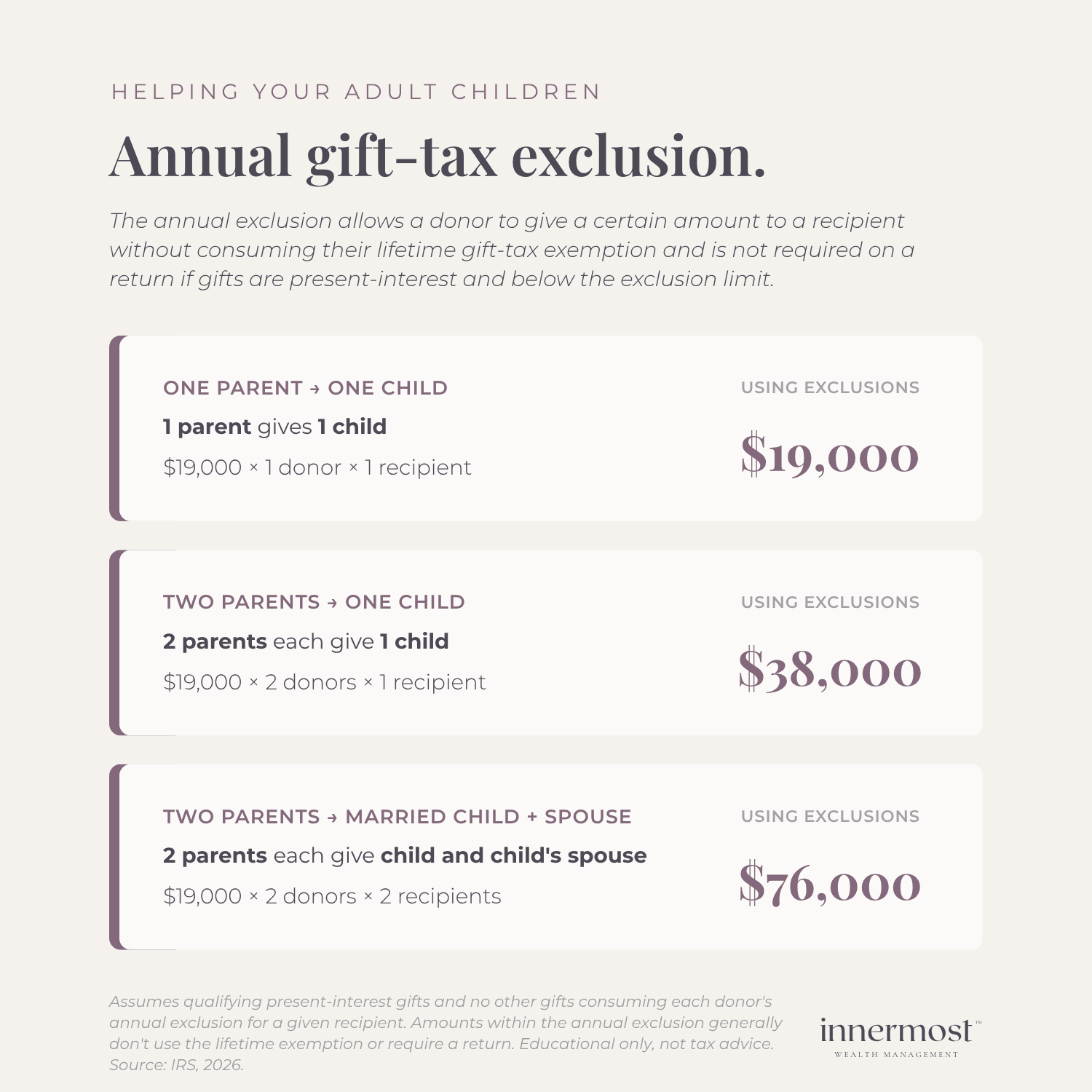
The annual exclusion is per donor, per recipient — so a couple helping a married child can transfer $76,000 in 2026 without touching their lifetime exemption.
Tuition and medical expenses have separate rules.
Federal gift-tax law provides separate exclusions for certain qualifying tuition and medical payments made directly to the institution or provider.
Amounts paid directly to a qualifying educational institution for someone’s tuition can qualify for the federal gift-tax educational exclusion.
The payment must go directly to the school.
It does not cover:
Room and board
Books
Supplies
Other non-tuition expenses
Similarly, qualifying medical expenses paid directly to the medical provider can qualify for the medical exclusion.
That can include certain medical insurance payments as well.
These direct payments generally do not use the $19,000 annual exclusion or the lifetime basic exclusion.
For example, a grandparent could pay $30,000 of a grandchild’s qualifying tuition directly to the university and separately make a $19,000 qualifying cash gift to the grandchild in the same year without the tuition payment consuming the annual exclusion.
The rules are specific, so large direct payments should still be coordinated with a tax professional.
Lifetime gifts and estate planning need to use the same rules.
If you give one child substantially more during your lifetime, decide what that means when the estate is eventually divided.
You have several choices.
You can say:
Lifetime gifts do not affect the inheritance.
You can say:
Major lifetime gifts count against each child’s eventual inheritance.
Or you can use a more flexible formula.
None of those is automatically better.
What matters is that the estate documents match what you actually intend.
This is also where records matter. If you intend to equalize a $100,000 home gift twenty years from now, your executor needs to know:
That the gift occurred
Whether it was intended as an advancement
What value should be attributed to it
How the estate documents direct the adjustment
Do not leave that decision for your children to negotiate with each other after your death.
A practical framework before you give.
Before making a significant gift to an adult child, answer these questions:
Can we give this amount away permanently without weakening our own retirement?
How much do we expect to give across all of our children over our lifetimes?
Are we trying to be equal, needs-based, or equalized through the estate?
What specific problem or opportunity will this money address?
Is this a gift, a loan, or direct payment of an expense?
Does the gift create a Form 709 or other tax-reporting requirement?
Should this gift affect the child’s future inheritance?
What do the other children need to know?
Have our financial plan and estate documents been updated to reflect the decision?
Those answers are more useful than trying to find one universal definition of “fair.”
Helping adult children is one of the places where financial planning becomes very concrete. The goal is to use money in a way that supports your children without weakening your own security or leaving the family to sort out unclear decisions later.
If you are considering meaningful lifetime gifts, financial planning can help evaluate how different gifting amounts and timing assumptions may affect retirement sustainability, liquidity, and your broader estate strategy. We can help you evaluate those tradeoffs within the context of your overall financial plan.
Frequently asked questions about helping adult children financially.
-
It can be okay to give one child more money than another, and in many families it may be the fairer choice. Fairness depends on each child's actual circumstances, needs, and stage of life, not necessarily on identical dollar amounts. What matters most is that the decision is deliberate and, in many cases, communicated thoughtfully so it does not create unnecessary surprise or resentment later.
-
In 2026, you can generally give up to $19,000 per recipient in qualifying present-interest gifts without using any of your lifetime basic exclusion amount, and a married couple may be able to use their separate annual exclusions to give a combined $38,000 to the same person. Larger gifts generally require filing IRS Form 709, but filing a gift-tax return does not necessarily mean gift tax is immediately due. For 2026, the federal basic exclusion amount is $15 million per individual. Payments made directly to a qualifying educational institution for tuition or directly to a medical provider for qualifying medical expenses may qualify for separate gift-tax exclusions.
-
In many cases, some level of transparency can help reduce the risk of surprise or misunderstanding later. That does not mean every child needs to know the details of a sibling's finances. Some situations warrant more privacy, but families may benefit from communicating the general approach being used for significant gifts.
-
For parents whose retirement is secure and who expect to leave an inheritance, providing help earlier in a child's life may sometimes have more impact than leaving the same amount decades later. Money used for a home purchase, education, business opportunity, childcare, or another major need may affect a child's financial path differently depending on when it is received. The tradeoff is that money given away today is no longer available for the parents' future needs or continued investment. The decision should be evaluated in the context of the parents' overall financial plan.
-
There is no way to guarantee that financial help will avoid family conflict, but planning ahead can reduce the risk of misunderstandings. Decide how you want to approach fairness across children, communicate the general framework when appropriate, and keep records of significant gifts so they can be coordinated with your estate plan. The appropriate approach may involve equal amounts, needs-based support, or accounting for unequal lifetime gifts through the estate.
Educational content only. Not personalized tax, legal, or investment advice. Tax figures are current for 2026 and may change. Gift, estate, and tax rules depend on your individual circumstances; consult a qualified tax or legal professional for your situation.
Sources:
Harvard Joint Center for Housing Studies. “Home Prices Surge to Five Times Median Income, Nearing Historic Highs.” Harvard JCHS article
National Association of REALTORS®. Existing-Home Sales reports, 2026. NAR Existing-Home Sales data
Freddie Mac. Primary Mortgage Market Survey. Freddie Mac mortgage rates
Pew Research Center. “Majorities of Americans say key financial milestones are harder for today’s young adults to reach,” July 17, 2026. Pew Research Center article
USAFacts / U.S. Census Bureau ACS. Detroit metro median gross rent of approximately $1,207/month, 2020–2024. USAFacts Detroit rent data
Internal Revenue Service. Frequently Asked Questions on Gift Taxes / Gifts & Inheritances. IRS gift-tax FAQs
Internal Revenue Service. “What’s New — Estate and Gift Tax.” IRS estate and gift tax updates
Internal Revenue Service. Instructions for Form 709. IRS Form 709 instructions
Internal Revenue Service. Publication 550. IRS Publication 550