
The Job-Change Financial Checklist (What to Handle Before You Give Notice)

Key Takeaways
Some of what you would leave behind does not appear on your paystub. Check your 401(k) vesting schedule and equity vesting dates before giving notice. Leaving even a few weeks before a milestone could mean forfeiting compensation that was nearly yours.
The highest salary is not automatically the best offer. Understand the type of equity you are receiving, read the repayment terms on any sign-on bonus, and confirm when your benefits begin. A compensation package can look better in the headline than it does in the details.
Your final day is a financial decision. Health coverage, unused PTO, bonuses, and vesting milestones may all depend on the date you choose, so choose it deliberately.
When a new offer comes in, the details that cost you money are easy to skip past.
The employer match you forfeit by leaving too early. The equity that turns out to be worth less than it sounded. The gap in health coverage nobody mentions until you are already in it.
None of this is necessarily hidden. It is usually sitting in plan documents, grant agreements, employee handbooks, and offer letters that most people do not feel like reading when they are ready to accept a new job.
This job change financial checklist has two parts. The first covers the money and benefits that may determine whether the move is as financially attractive as it looks. The second covers the parts of the decision that do not fit neatly into a compensation spreadsheet.
We will take them in that order.
Start with what you would leave behind.
It helps to begin with what you already have, because some of it may not be fully yours yet.
Check your 401(k) vesting schedule.
Your own 401(k) contributions and the earnings belong to you from the start. Employer contributions may be different.
Depending on the plan, an employer match may vest immediately or over time. Many traditional plans use either a cliff schedule, under which you become fully vested after completing a specified period of service, or a graded schedule that increases your vested percentage over several years.
A three-year cliff, for example, could mean that you are 0% vested in the employer contribution until you complete three years of service and 100% vested afterward. Under a graded schedule, you may keep a larger percentage of the employer contribution the longer you stay.
Plans can differ in how they calculate service, so do not rely only on your hire-date anniversary. Check your Summary Plan Description or ask the plan administrator to confirm:
your current vested percentage
the dollar amount you would keep if you left today
the date of your next vesting milestone
how the plan defines a year of service
Leaving shortly before a major vesting date can be an expensive timing mistake.
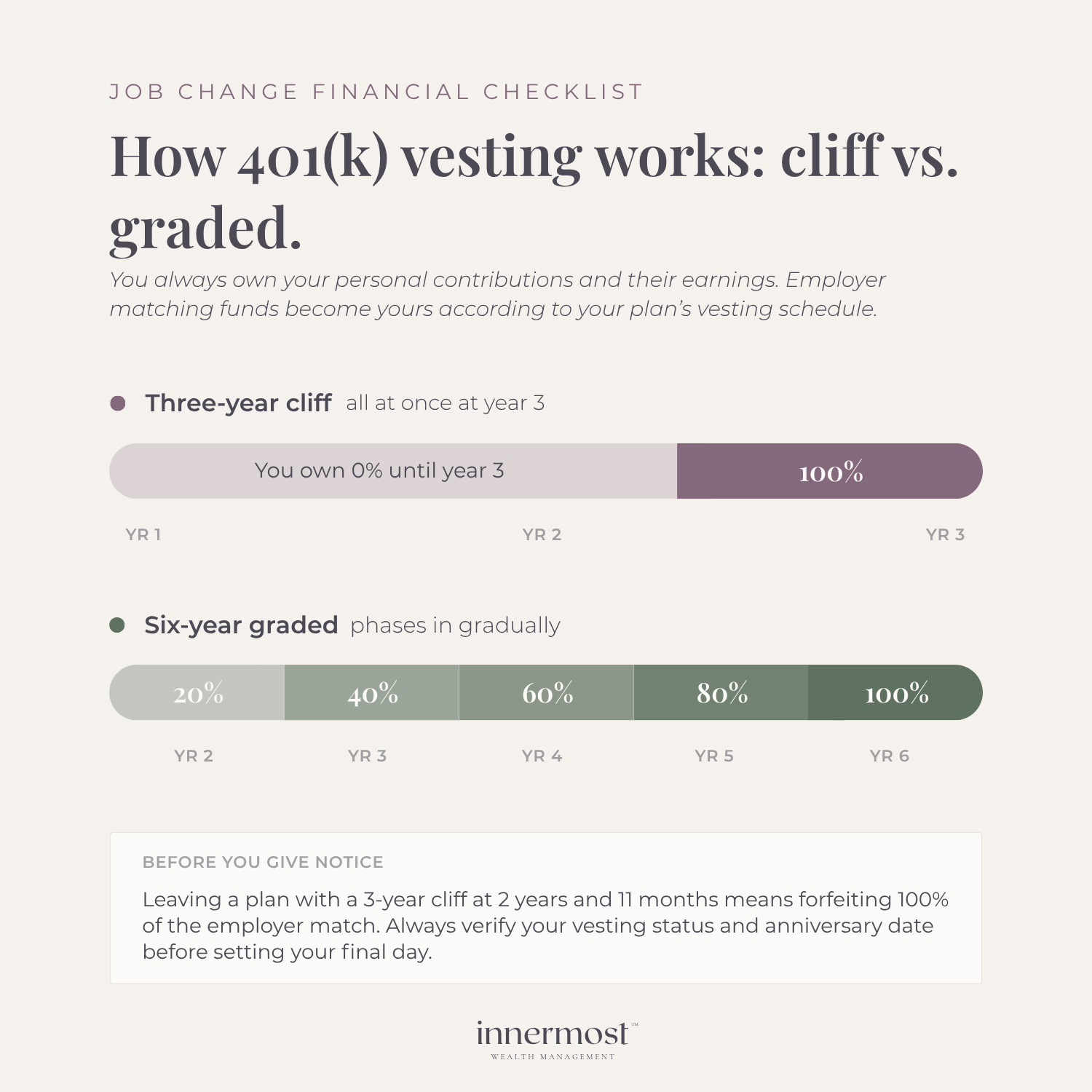
Employer matching funds become yours according to your plan’s vesting schedule. A cliff schedule holds all funds back until you hit the mark, while a graded schedule phases them in year by year. Your own contributions and their earnings are always 100% yours. Be sure to check your plan’s Summary Plan Description (SPD) for its specific rules.
Review every equity grant separately.
Unvested equity is commonly forfeited when employment ends, although the exact treatment depends on the equity plan, grant agreement, and any separation arrangement.
Pull up each grant and check:
what type of equity you have
how much is vested and unvested
the next vesting date
whether vesting accelerates under any circumstances
what happens when your employment ends
whether vested stock options have an exercise deadline
Vested stock options often have a post-employment exercise window that is much shorter than the option’s original expiration date. The specific deadline comes from your plan and grant agreement.
Incentive stock options have an additional tax consideration. Exercising more than three months after employment ends will generally prevent the option from receiving ISO tax treatment, even if the plan still permits an exercise. That does not necessarily mean the option disappears after 90 days, but its tax treatment may change.
If you have equity vesting in the next several weeks or months, confirm the actual dates before deciding when to leave. The value at stake may justify delaying your departure—or asking the new employer to compensate you for what you are giving up.
If you have RSUs vesting soon, our guide to selling RSUs after vesting walks through the next decision.
Add up what you are forfeiting before negotiating.
Once you know what you would leave behind, put a number on it.
That may include:
an unvested 401(k) match
RSUs scheduled to vest
stock options you would lose
an annual or retention bonus
unused PTO that will not be paid
employer HSA contributions
tuition assistance or other benefits subject to repayment
You may not recover every dollar, but the total gives you a concrete basis for asking the new employer for a larger sign-on bonus, additional equity, or a later start date.
You can only make that case effectively after you have calculated what the move will cost you.
Read the whole offer, not just the salary.
Salary is the easiest number to compare, but it is only one part of what you are being offered.
A compensation package can be structured to look more generous than it is, and equity is often the part that creates the largest gap between the headline value and the value you may eventually receive.
Understand what type of equity you are receiving.
Restricted stock units and stock options are not interchangeable.
RSUs generally represent a promise to deliver shares or cash after the applicable vesting and settlement conditions are met. Public-company RSUs usually have a more observable value because the underlying shares have a market price. Private-company RSUs may be harder to value and may not become liquid when they vest.
Stock options give you the right to purchase shares at a specified exercise price. Exercising them requires your own money, and the option has economic value only when the company’s share value exceeds that exercise price.
Options in a private company may also be difficult to sell. A large number printed in an offer letter does not tell you:
the company’s current valuation
the option’s exercise price
the number of fully diluted shares outstanding
your ownership percentage
the vesting schedule
whether you will have a realistic opportunity to sell the shares
how future fundraising may dilute your ownership
Neither RSUs nor stock options are automatically better. The value depends on the company, the terms, the tax consequences, and the likelihood that the equity eventually becomes liquid.
A package built largely on options you must purchase is not equivalent to the same headline amount delivered through salary or liquid stock.
If equity is a meaningful part of the offer, our article on building wealth through employer equity explains how to evaluate its role over time.
Read the sign-on bonus terms.
A sign-on bonus is not always free money.
Many agreements include a clawback requiring you to repay some or all of the bonus if you leave within a specified period, commonly one or two years. The repayment amount may decline over time, or it may remain all-or-nothing until the obligation expires.
Before counting the bonus as part of the offer, confirm:
whether repayment is required
how long the repayment period lasts
whether repayment is prorated
what happens if the employer terminates you
whether the repayment obligation includes taxes withheld
A sign-on bonus is taxable compensation. The amount withheld from it may not equal the tax you ultimately owe, particularly if your income changes significantly during the year.
Negotiate the items that matter most.
Start with the pieces carrying the most financial value:
salary
sign-on bonus
equity
guaranteed bonus terms
start date
If the employer cannot move on those items, you may have more flexibility around:
additional PTO
remote or hybrid work
professional-development support
title
schedule
start date
a compensation review after six months
There is one more issue worth naming because it comes up with many of the women we work with.
Research has found that women can face social penalties for negotiating compensation in situations where the same behavior is received differently from men. Other studies have found that women ask for higher compensation more often than the conventional narrative suggests, indicating that context and how the request is received matters alongside the willingness to negotiate.
That is not a reason to avoid the conversation. It is a reason to prepare a specific, well-supported request.
Connect what you are asking for to:
the responsibilities of the role
your experience and results
credible market compensation data
the value you expect to contribute
compensation you will forfeit by leaving your current employer
A specific case is usually stronger than a general request to be paid more.
Time your exit around the calendar.
Some of the money involved in a job change comes down to the day you choose as your last one.
Confirm when health coverage ends and begins.
Do not assume your current health insurance continues through the end of the month. Depending on the plan, coverage may end on your last day, at the end of the month, or on another date specified in the plan documents.
Confirm the exact termination date with HR or the plan administrator before setting your final day.
At the new job, health coverage may not begin on your first day. Some plans impose a waiting period, which generally cannot exceed 90 days once you are otherwise eligible for coverage. Ask for the exact effective date before accepting the offer.
If there will be a gap, review your options in advance. Depending on your circumstances, they may include:
COBRA continuation coverage
a spouse’s employer plan
a Marketplace plan through a Special Enrollment Period
another individual health plan
The right choice depends on the length of the gap, premiums, deductibles, provider networks, ongoing treatment, and prescriptions.
Check your PTO payout rules.
Unused PTO may become a payout, a use-it-before-you-leave deadline, or something in between.
The result depends on the type of leave, the employer’s written policy, any employment agreement, and applicable state law. Federal law does not generally require employers to provide paid vacation or pay unused vacation when employment ends.
Before selecting your last day, confirm:
your current balance
which types of leave are eligible for payout
whether the payout is calculated at your current pay rate
whether advance notice affects eligibility
whether unused time must be taken before your departure
Do not assume the balance shown in the HR portal will automatically appear in your final paycheck.
Place your last day against the vesting calendar.
The vesting dates from the first section become a scheduling decision here.
If a 401(k) contribution, bonus, or block of equity vests a few weeks after the day you planned to leave, moving your departure may be worth a meaningful amount.
Compare your proposed last day with:
401(k) vesting milestones
equity vesting dates
bonus eligibility dates
profit-sharing contribution dates
employer HSA contributions
PTO payout rules
health insurance termination dates
Your last day should not be chosen only by working backward from the new job’s start date.
Plan for any gap between jobs.
Even a short break between jobs deserves a plan.
Estimate the cash you will need for:
regular living expenses
health insurance premiums
medical costs
travel or relocation
a delayed first paycheck
retirement-plan contributions that will temporarily stop
benefits you will begin paying for yourself
A delayed start date or payroll cycle should not create financial pressure during an already busy transition.
Use your FSA correctly before leaving.
A health flexible spending account is generally use-it-or-lose-it, and unused funds may be forfeited when your participation ends.
Before leaving, confirm:
the last date on which you can incur eligible expenses
the deadline for submitting claims
whether the plan offers a grace period or carryover
whether a run-out period allows later claim submission
whether limited COBRA continuation is available
The date an expense is incurred usually matters more than the date you submit the receipt, so review the plan before scheduling purchases or appointments.
Remember that your HSA is yours.
A health savings account belongs to you regardless of where you work.
You can generally keep the account, use it for qualified medical expenses, and transfer it to another HSA provider. Whether you can continue making contributions depends on whether your new health plan qualifies as an HSA-eligible high-deductible health plan and whether you meet the other eligibility requirements.
Do not confuse the portability of the account with continued eligibility to contribute.
Your new job financial checklist.
Once you have accepted and started the new role, handle the important setup tasks before they disappear beneath everything else you are learning.
Set your retirement-plan contribution.
Enroll in the new retirement plan as soon as you are eligible.
At a minimum, understand:
when you can enroll
when the employer match begins
whether contributions are automatically increased
whether the plan offers Roth and pretax contributions
how employer contributions vest
which investment option will apply if you make no election
Contributing enough to receive the full available match is often a reasonable starting point, but the right savings rate depends on your cash flow, debt, tax situation, and broader plan.
Complete your benefit elections.
Choose your health, dental, vision, disability, life insurance, HSA, FSA, and other benefits within the enrollment window.
Pay particular attention to:
the coverage effective date
deductibles and out-of-pocket limits
HSA or FSA contribution elections
employer-paid versus optional disability coverage
life insurance amounts and beneficiary designations
dependent-care benefits
deadlines that cannot be reopened until the next enrollment period
Review your tax withholding.
Update your Form W-4, especially if:
your income changed significantly
you received a sign-on bonus
you had more than one employer during the year
your spouse also works
you exercise stock options or receive equity compensation
you expect substantial investment or business income
The withholding on an individual paycheck does not determine your final tax bill. Estimate the full-year result rather than assuming payroll withholding will be correct automatically.
Our guide to managing taxes as a high earner explains how a change in income can affect withholding and estimated taxes.
Consider what to do with your previous 401(k).
Your options may include:
leaving the account in your former employer’s plan, if permitted
rolling it into your new employer’s plan, if accepted
rolling it into an IRA
taking a taxable distribution
There is no universal best choice. Each option can affect your costs, investment choices, access to the money, tax strategy, and broader retirement plan.
Consider:
administrative and investment fees
available investment options
withdrawal rules
creditor protections
access to lower-cost or institutional investments
outstanding plan loans
whether the age-55 separation rule may apply
how a pretax IRA balance could affect future backdoor Roth contributions
the convenience of consolidating your accounts
Work with a financial planner to compare the options in the context of your full financial plan. A tax professional may also be helpful when the decision involves a taxable distribution, Roth conversion, after-tax contributions, or other tax considerations.
Before cashing out the account, make sure you understand the potential income taxes and additional tax penalties, as well as the long-term effect of removing the money from your retirement savings.
Weigh more than the salary.
The offer letter captures only part of the decision.
Many of the factors that determine whether a move is right will not appear in a side-by-side comparison of compensation and benefits.
Consider the value and costs that do not appear in the offer letter.
Compensation is only one part of the financial picture.
When comparing opportunities, also consider:
commuting time and costs
parking
gas and vehicle wear
work clothes
childcare needs
lunches and convenience spending
expected working hours
flexibility and control over your schedule
paid time off and other benefits
the time and energy available for life outside work
Some of these factors have a clear dollar value. Others are harder to quantify, but they still add value or create a cost.
Consider how each role compares across the full package, including compensation, benefits, expenses, time, flexibility, and the effect it may have on the rest of your life.
Consider what the move creates over time.
Not every good career move comes with an immediate increase in title or pay.
A lateral move may still be worthwhile if it:
develops a valuable skill
gives you stronger leadership or mentorship
helps you enter a different industry
provides exposure to work you want to pursue
creates a path toward future ownership or leadership
strengthens your credibility or professional network
gives you a more sustainable way to work
A role with similar pay may ultimately be more valuable if it opens an important door, while a raise may matter less if it moves you further from the kind of work or future you want.
Ask what the move offers now and what it may make possible later.
Consider the environment you are both leaving and entering.
What kind of work environment are you leaving, and what evidence do you have about the one you are entering?
Earlier in my career, I underestimated how much workplace culture could shape the experience of a job. I assumed that if the role, compensation, and opportunity looked good enough, I could adapt to almost any environment.
I would give the environment much more weight now.
A healthy workplace can offer stability, trust, reasonable expectations, supportive leadership, and room to do good work. An unhealthy one can make even an attractive role difficult to sustain.
That does not mean every frustrating or unfulfilling job is toxic. Many people feel relatively neutral about work. The role may not be especially exciting, but the culture is steady, the expectations are manageable, and the people are respectful. That kind of environment can have real value.
The opposite can also be true. A new opportunity may look better on paper, but you may know very little about how decisions are made, how employees are treated, or what the culture is like in practice.
This is especially important during a demanding season of life. If your current environment is healthy and predictable while you are moving, getting married, caring for a family member, or preparing to have a child, keeping that stability may be worth more than it would at another time.
Workplace culture can be part of the value or cost of the job.
Who to have in your corner.
A job change asks you to evaluate compensation, benefits, taxes, equity, timing, career direction, and how you want to live.
That is a lot to hold at once, especially while you are excited about an offer or eager to leave your current role.
A financial planner can help you compare the financial consequences, identify tradeoffs, and model how the decision affects the rest of your plan. An employment attorney can review contractual or legal concerns. A tax professional can help with complex equity, withholding, or repayment questions. The governing plan and employment documents should always be reviewed before you act.
You do not have to sort through every piece alone.
If you are weighing a move and want help evaluating the full picture, we would be glad to talk.
Frequently asked questions about what to consider when changing jobs.
-
Review what you may leave behind, including unvested 401(k) contributions, equity, bonuses, PTO, and employer benefits. Compare the full new compensation package, confirm when health coverage begins and ends, plan for any gap between jobs, and complete your new benefit, retirement, and withholding elections promptly.
-
You keep the portion of the employer contribution in which you are vested. Any unvested amount is generally forfeited when employment ends. Your own contributions and the earnings on them remain yours. Check the Summary Plan Description for your plan’s exact vesting rules.
-
Unvested RSUs and stock options are commonly forfeited when employment ends, although your grant documents control. Vested stock options may remain exercisable for a limited period. Review each grant’s vesting schedule, exercise deadline, tax treatment, and termination provisions before giving notice.
-
There is no universally best day. Compare potential dates against health insurance termination, PTO payout, bonus eligibility, 401(k) vesting, equity vesting, and the start date of your new benefits. A difference of several days or weeks can sometimes have meaningful financial consequences.
-
Compare bonuses, equity, retirement benefits, healthcare costs, paid leave, working hours, flexibility, commuting expenses, career trajectory, and the health of the work environment. Consider both what the role pays and what it will require from the rest of your life.
-
Possibly. A lower-paying job may be the stronger choice when it meaningfully improves your health, flexibility, time, or long-term career direction. The decision depends on whether the lower compensation still supports your financial needs and whether the nonfinancial benefits are genuinely valuable to you.
-
Complete your benefit elections, set your retirement contribution, review the employer match and vesting schedule, update your withholding, choose beneficiaries, plan for the first paycheck, and evaluate the options for your former employer’s retirement plan.
This material is provided for general educational purposes and is not individualized investment, tax, legal, benefits, or employment advice. Employer plans, equity awards, offer terms, and applicable state laws vary. Review the governing documents and consult the appropriate financial, tax, legal, or benefits professional regarding your circumstances.