
Umbrella Insurance: The Coverage That Protects What You've Built (for a Dollar a Day)

Key Takeaways
Umbrella insurance adds another layer of liability protection when a covered claim exceeds the limits of your home or auto policy. For high earners, those standard limits may be much lower than the assets and future earning power at stake.
The coverage is affordable. A $1 million policy may cost approximately $150 to $400 a year, although pricing varies by insurer, location, and household risk profile. Additional coverage may cost less per million than the first layer.
The underlying limits matter. Umbrella policies generally require you to maintain certain liability limits on your home and auto insurance. If those limits fall below the policy’s requirements, you may be responsible for part of a claim before the umbrella begins paying.
Picture the drive home after a closing, after getting a promotion, or on the day the last of your student loans finally cleared. You have been building for years: the income, the house, the retirement accounts you can finally enjoy watching grow. Maybe you are also the person whose paycheck holds most of your household’s financial life together.
Now picture a different afternoon.
The road is wet. You are stopped at an intersection, you roll forward, and you do not see the motorcycle until you have hit it. The rider’s leg breaks in three places. There is surgery, then another surgery, followed by months when he cannot work. His lawyer seeks $1 million in damages.
For this example, assume your auto policy carries a $500,000 liability limit. If the full $1 million is awarded and the claim is covered under your policy, your auto insurance may pay up to that limit.
You could be personally responsible for the remaining $500,000. Depending on state law and which assets are legally protected, the judgment could reach personal savings, nonretirement investments, or a portion of future wages.
Most high earners never picture that afternoon, which is exactly the kind of financial exposure umbrella insurance is designed to address. It can be a cost-efficient way to add substantial liability protection. At Innermost, it is one of the protections we review once a client has meaningful assets or income to protect.
So, let’s walk through how it works, what it covers, how much coverage to consider, and what it may cost.
What is umbrella insurance?
Umbrella insurance is additional liability coverage that sits above the liability limits on your existing home, auto, and other eligible policies.
Your underlying insurance pays first. If a covered claim exceeds that policy’s liability limit, the umbrella may cover the remaining amount, up to its own limit and subject to its terms and exclusions.
In the accident example above, an umbrella policy could provide the additional layer of coverage between the auto policy’s limit and the total covered claim. Without it, some or all of that difference could become your responsibility.
That is the basic idea: your home and auto policies provide the first layer of protection, and an umbrella adds another layer between a serious liability claim and your personal finances.
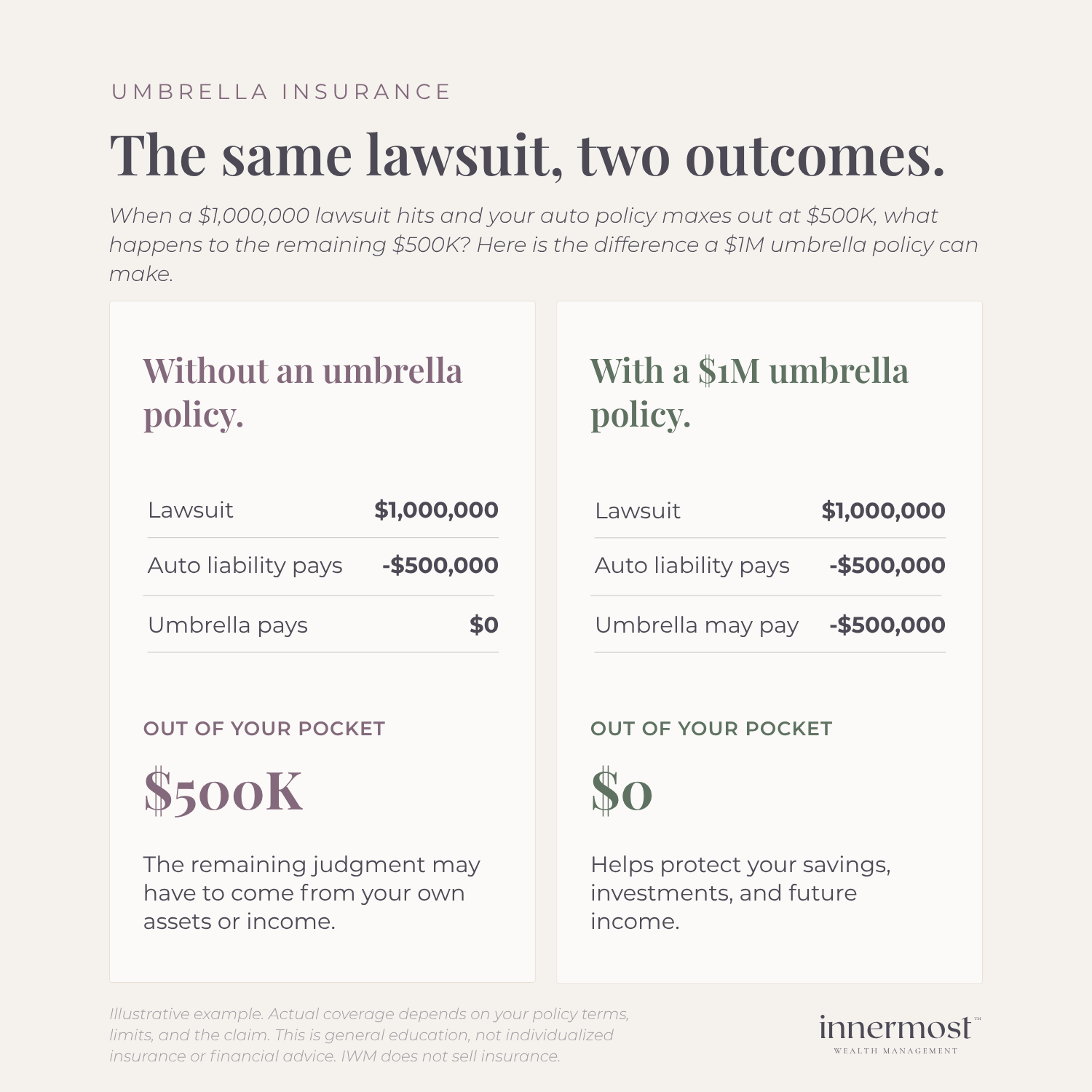
Without an umbrella policy, a lawsuit that runs past your auto or home policy coverage limit can come out of your savings, investments, and future paychecks.
Why high earners have more at stake.
There is an irony in how liability works: the more you build, the more you may have at risk, and the less your standard insurance limits may cover relative to what is at stake.
Many home and auto policies carry liability limits of approximately $300,000 to $500,000. But when you have substantial home equity, a growing investment portfolio, and years of strong earnings ahead of you, those limits may no longer reflect your financial exposure.
A judgment does not necessarily stop at your insurance limit. Depending on applicable law and available asset protections, personal assets or a portion of future earnings may remain exposed.
Serious liability claims can exceed standard policy limits. A catastrophic injury, prolonged medical treatment, lost income, and legal expenses can push a claim beyond $1 million and above the liability coverage the average household carries.
These are not ordinary fender-benders. They are the rare, costly events umbrella insurance is designed to address.
If your income is the engine of your household, your future earning power is one of your largest financial assets, even though it never appears on a net worth statement. Depending on state and federal law, a judgment may place a portion of future wages at risk.
People often think of disability and life insurance as the primary ways to protect their income, while overlooking the role liability insurance can play in protecting the financial life that income supports.
It also helps to understand the ordinary situations that can create this exposure, because they are rarely spectacular.
A teenager on your auto policy causes a serious crash. A guest is injured at your home. A delivery driver slips on your steps. Your dog bites someone. An online comment leads to a defamation claim. Even a seemingly routine collision can become expensive when injuries, medical bills, and lost wages are more severe than anyone initially realized.
None of these situations requires extreme recklessness. They are familiar risks that come with driving, owning property, raising a family, and living a full life. Any one of them can produce a claim that exceeds the limits of a standard policy.
What umbrella insurance covers.
Most people think of umbrella insurance as backup for a serious car accident, and that is a major part of what it does. But depending on the policy, it may also provide protection for certain liability claims that your home or auto insurance does not cover—or does not cover as broadly.
That can include personal injury claims involving libel, slander, false arrest, or invasion of privacy. Coverage may also extend to liability connected to a rental property or an injury involving a guest on your property.
If you serve on a nonprofit or community board, it is worth asking whether that activity is covered, since volunteer leadership can create liability that is easy to overlook.
The details vary by contract. Business or professional liability, intentional acts, and damage to your own property are commonly excluded, so it is important to review the policy rather than assume every type of liability is covered.
An umbrella is not only protection against the dramatic highway accident. It is a broader backstop for the ordinary ways an ordinary life can produce an extraordinary claim.
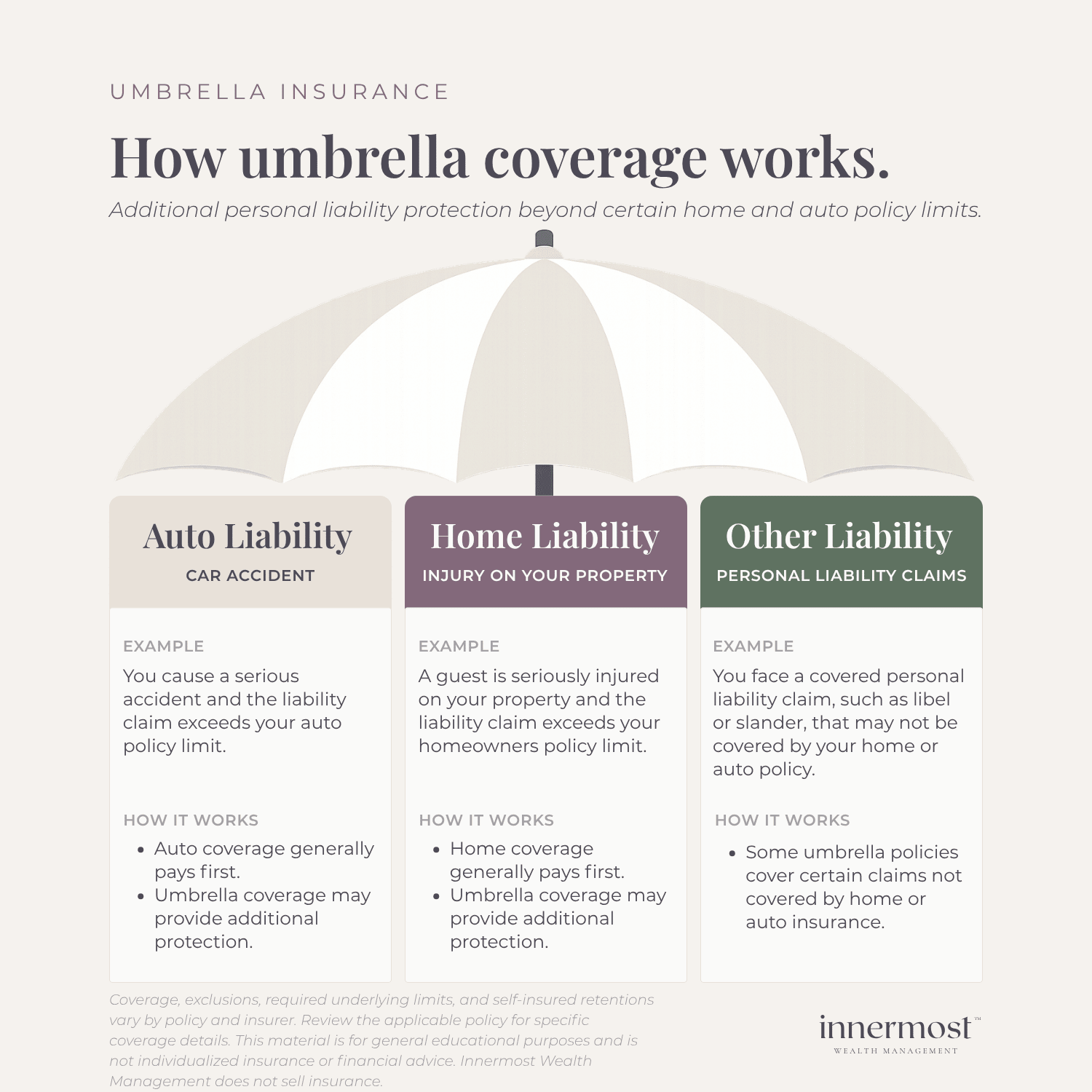
Umbrella insurance acts as a secondary layer of protection, stepping in when covered auto, home, or personal liability claims exceed your standard policy limits.
How much umbrella coverage should you consider?
One common starting point is to compare your umbrella limit with your net worth, then consider future income, applicable asset protections, and household risk factors.
Add up the assets you would want to protect, such as your home equity, investment and savings balances, and other valuable property, and use that figure as a starting point for the conversation.
Some advisors also consider one or two years of household income because, depending on applicable law, a portion of future earnings may be exposed to a judgment. A household with a net worth of $1.5 million and substantial income, for example, might consider pricing out $2 million or $3 million of coverage rather than stopping at $1.5 million.
Your personal risk factors matter too. A teen driver, pool, trampoline, rental property, or nonprofit board position may be a reason to consider a higher limit.
The goal is not to arrive at a perfect number from a formula. It is to choose an amount that reflects both what you have built and the risks present in your life.
Here is a quick gut check: do you know the liability limits on your current home and auto policies?
Most people do not. They are buried in policy documents that few people read closely, and they may be much lower than the amount you would want standing between a serious claim and your personal finances.
Umbrella coverage is commonly sold in increments of $1 million, and additional coverage may cost less per million than the first layer. That brings us to the number that often makes this conversation easier: what umbrella insurance actually costs.
What umbrella insurance costs.
For the amount of liability protection it can provide, umbrella insurance is often relatively affordable. A $1 million policy may cost approximately $150 to $400 a year, although pricing varies. Additional coverage often costs less per million than the first layer, but the actual increase depends on the insurer and your household risk profile.
Put in everyday terms, that is approximately $13 to $33 per month to add another layer of protection between a serious liability claim and your personal finances.
Pricing depends on factors such as where you live, the number of vehicles and drivers in your household, prior claims, rental properties, pools, and teen drivers.
Treat these figures as general starting points rather than a quote for your household. Even when the premium falls above the typical range, umbrella insurance can still be a cost-efficient way to add substantial liability protection.
Umbrella insurance requirements: avoid the coverage gap.
This is where the details matter. Buying an umbrella policy does not automatically eliminate every potential gap in your coverage.
Umbrella insurers generally require you to maintain minimum liability limits on your underlying home and auto policies. Those requirements are often around $300,000 for homeowners liability and $250,000 per person and $500,000 per accident for auto liability, although the exact limits vary by insurer.
The umbrella is designed to sit above those underlying limits. If your home or auto coverage falls below the amount required by the umbrella policy, you may be responsible for the difference between where the underlying policy ends and where the umbrella coverage begins.
For example, suppose your umbrella requires underlying auto liability limits of $250,000 per person and $500,000 per accident, but your auto policy carries only $100,000 per person and $300,000 per accident.
If a large claim occurs, you could be responsible for the difference between your actual limits and the limits required by the umbrella policy before the umbrella begins paying, depending on the terms of the contract.
The fix is straightforward: when you purchase an umbrella policy, confirm that your home and auto liability limits satisfy its underlying coverage requirements.
Raising those limits may increase your premiums, but it is a normal part of putting the coverage in place correctly. Ask your insurance professional to confirm the required limits in writing rather than assuming the policies align.
When your protection needs to catch up.
Building wealth and protecting it require different skills, and protection is often the part people postpone.
If your income, assets, or household responsibilities have grown since you last reviewed your insurance, it may be time to take another look at your liability limits.
A financial planner can help you think through what you want to protect and which risks deserve attention. A licensed insurance professional can then help you compare coverage limits, policy terms, exclusions, underlying requirements, and pricing.
Frequently asked questions about umbrella insurance.
-
Umbrella insurance covers liability claims that exceed the limits of your home and auto policies, up to the umbrella's own higher limit. Beyond car accidents, it can also cover personal liability situations that standard policies often exclude, such as libel, slander, defamation, false arrest, rental-property liability, and certain guest-injury claims. It's designed as a broad backstop against large claims that could otherwise reach your savings, investments, and future income.
-
A common rule of thumb is to carry umbrella coverage at least equal to your net worth. Add up your home equity, investments, savings, and other property, then round up to the nearest million. Many planners suggest adding one to two years of income on top, since your future earnings are also exposed in a lawsuit. Households with higher-risk factors like a teen driver, pool, or rental property often size up further.
-
Umbrella insurance typically costs around $150 to $400 per year for $1 million in coverage, with each additional million usually adding only about $75 to $150 annually. That makes higher limits relatively inexpensive. Costs run higher in more litigious states like California, New York, and Florida, and household factors like teen drivers or a pool can raise the premium, so these ranges are a starting point rather than a quote.
-
High earners are often the people who benefit most from umbrella insurance. Standard home and auto policies cap liability around $300,000 to $500,000, which frequently falls short of what a high earner would lose in a large judgment, including future income. Since roughly 13% of personal liability claims exceed $500,000, the extra layer protects assets and earning power that standard coverage leaves exposed.
-
Umbrella policies sit on top of your existing home and auto liability coverage, so insurers usually require minimum underlying limits, often around $300,000, before the umbrella applies. If your underlying limits are lower than required, a gap can open between where those policies stop and where the umbrella begins, leaving you responsible for the difference. Raising your home and auto limits to meet the requirement closes that gap.
-
For someone with meaningful assets or high future income, umbrella insurance offers one of the best ratios of protection to cost in personal finance. A few hundred dollars a year can protect against a rare but financially devastating liability claim. The value comes from covering catastrophic, low-probability events, the kind that standard policies aren't built to absorb and that could otherwise undo years of building.
This article is for general educational purposes and is not insurance, legal, or financial advice. Coverage terms, requirements, and costs vary by carrier, state, and individual circumstances. Confirm specifics with a licensed insurance professional and review your own policies before making decisions.