
Retiring in Michigan: The Complete Financial Checklist

Key Takeaways
Michigan offers several tax provisions that can benefit retirees. Social Security is excluded from Michigan taxable income, and qualifying military retirement benefits can generally be subtracted. Under Michigan’s fully phased-in retirement-and-pension subtraction, eligible taxpayers may subtract up to $67,610 on a single return or $135,220 on a joint return of qualifying retirement income for 2026. Michigan generally does not impose a state estate or inheritance tax for people dying today, although federal estate-tax rules may still apply.
Medicare deadlines deserve attention well before age 65. For most people, the Initial Enrollment Period lasts seven months. Enrolling late without qualifying for an exception can lead to ongoing penalties or gaps in coverage.
The decisions work together. Taxes, property, healthcare timing, withdrawal sequencing, Social Security, and estate documents can affect one another. Reviewing them together can help you make better decisions before you retire.
Retiring in Michigan brings a few state-specific issues that are worth understanding before you leave work.
Michigan’s treatment of retirement income became more favorable in 2026, but state income taxes are only one part of the picture. Moving can change your property tax bill. Medicare has enrollment deadlines around age 65. The order in which you use your retirement accounts can affect federal taxes and Medicare premiums. And the estate plan you put together years ago may no longer reflect what you want today.
These are the major items I would review before retiring in Michigan.
How Michigan taxes your retirement income.
Social Security is not taxed by Michigan.
Michigan allows Social Security benefits included in federal adjusted gross income to be subtracted when calculating Michigan taxable income. Federal income tax may still apply to a portion of your Social Security benefits.
Michigan’s retirement-and-pension subtraction is fully phased in.
Michigan began phasing in expanded treatment of retirement and pension income in 2023. That phase-in reaches 100% in 2026.
Under the fully phased-in method, eligible taxpayers can subtract up to $67,610 on a single return or $135,220 on a joint return of qualifying retirement and pension income for 2026, regardless of birth year. The maximum amounts are adjusted over time.
Qualifying income generally includes many pensions, IRA distributions, and distributions from employer retirement plans reported on Form 1099-R. However, not every distribution automatically qualifies. Deferred compensation and certain employee contributions, for example, may receive different treatment.
The fully phased-in method is also not necessarily the only calculation available. Michigan retains other retirement-income calculation methods, and the result can differ based on your age, the source of the income, and the options available for the tax year.
A change effective for tax years 2026 through 2028 also allows certain Michigan taxpayers born after 1952 who are at least 67 to claim both the state’s standard deduction and the Social Security subtraction, rather than reducing the standard deduction by the Social Security amount. The standard deduction is still reduced by the personal exemption amount.
For retirement income that remains taxable, Michigan’s individual income tax rate is 4.25% for the 2026 tax year.
Military retirement benefits receive separate treatment.
Qualifying military retirement benefits for service in the United States Armed Forces can generally be subtracted from Michigan taxable income to the extent they are included in federal adjusted gross income.
For someone with several sources of retirement income, the state subtraction is only one part of the tax calculation. IRA and 401(k) withdrawals can affect your federal tax bracket, the taxation of Social Security, and income-related Medicare premiums even when Michigan treats some or all of that retirement income favorably.
A qualified tax professional can help you determine which income qualifies and which available calculation produces the best result for your return.
What to review.
☐ Identify which of your retirement-income sources may qualify for a Michigan subtraction
☐ Compare the Michigan retirement-income calculation methods available to you
☐ Account for federal income taxes and Medicare IRMAA when making withdrawal decisions
☐ Check whether military or other special retirement-income treatment applies to you or your spouse
Michigan property taxes in retirement.
Property taxes deserve a separate review, particularly if you plan to move after retiring.
Confirm your Principal Residence Exemption.
Michigan’s Principal Residence Exemption, or PRE, exempts a qualifying principal residence from local school operating millage of up to 18 mills. It is separate from the Homestead Property Tax Credit claimed on a Michigan income tax return.
If you recently bought a home, changed how it is titled or used, or are unsure whether the exemption appears on your property record, check with your local assessor.
Understand what happens to property taxes when you move.
Michigan generally limits annual increases in a property’s taxable value to the rate of inflation or 5%, whichever is lower, except for additions and certain ownership changes. Someone who has owned a home for many years may therefore have a taxable value well below the property’s current market value.
When a transaction qualifies as a transfer of ownership, the property’s taxable value generally uncaps in the calendar year after the transfer. That can produce a significant increase in the new owner’s property tax bill. Some transfers are excluded from the uncapping rules, so the treatment depends on the transaction.
This matters in two directions.
If you have owned your Michigan home for a long time, moving means giving up its existing capped taxable value. If you are buying another home, the seller’s current property tax bill may not be a reliable estimate of what you will pay after the property uncaps.
Use the expected post-uncapping tax bill when comparing the cost of staying versus moving. Michigan Treasury provides a property tax estimator, but your local assessor can help you understand the property’s specific treatment.
Check whether you qualify for property-tax relief.
Michigan offers a Homestead Property Tax Credit for qualifying homeowners and renters. Eligibility depends on factors including residency, total household resources, the property’s taxable value, and whether you own or rent the home. The limits and maximum credit are adjusted over time.
Michigan also provides property-tax deferment in certain circumstances and an exemption for some qualifying disabled veterans. Eligibility rules should be confirmed using current state and local guidance.
What to review.
☐ Confirm that your Principal Residence Exemption is properly filed
☐ Estimate the post-uncapping property taxes before buying another Michigan home
☐ Check the current eligibility requirements for the Homestead Property Tax Credit
☐ Review any property-tax deferment or exemption programs that may apply to you
Medicare planning around age 65.
Know your Initial Enrollment Period.
For most people who become eligible for Medicare at 65, the Initial Enrollment Period lasts seven months:
Three months before your 65th-birthday month + your birthday month + three months after
If your birthday falls on the first day of a month, Medicare generally treats your eligibility as beginning one month earlier. Your coverage start date can also depend on when during the enrollment period you apply.
Enrolling on time matters because delaying Part B can result in an ongoing penalty unless you qualify for a Special Enrollment Period or another exception.
How the Part B late-enrollment penalty works.
The Part B late-enrollment penalty generally adds 10% of the standard Part B premium for each full 12-month period you could have enrolled in Part B but did not.
For most people who owe the penalty, it continues for as long as they have Part B. Exceptions can apply, including for people who qualify for certain Special Enrollment Periods or Medicare Savings Programs.
For example, delaying Part B for seven full years without qualifying for an exception can result in a 70% penalty.
Using the 2026 standard Part B premium of $202.90, the standard premium plus a 70% penalty would be approximately $344.90 per month before any income-related adjustment. Because the standard premium may change each year, the dollar amount of the penalty may change too.
Part D has a different penalty. Going 63 consecutive days or more without Medicare drug coverage or other creditable prescription coverage after your Initial Enrollment Period can result in a Part D late-enrollment penalty.
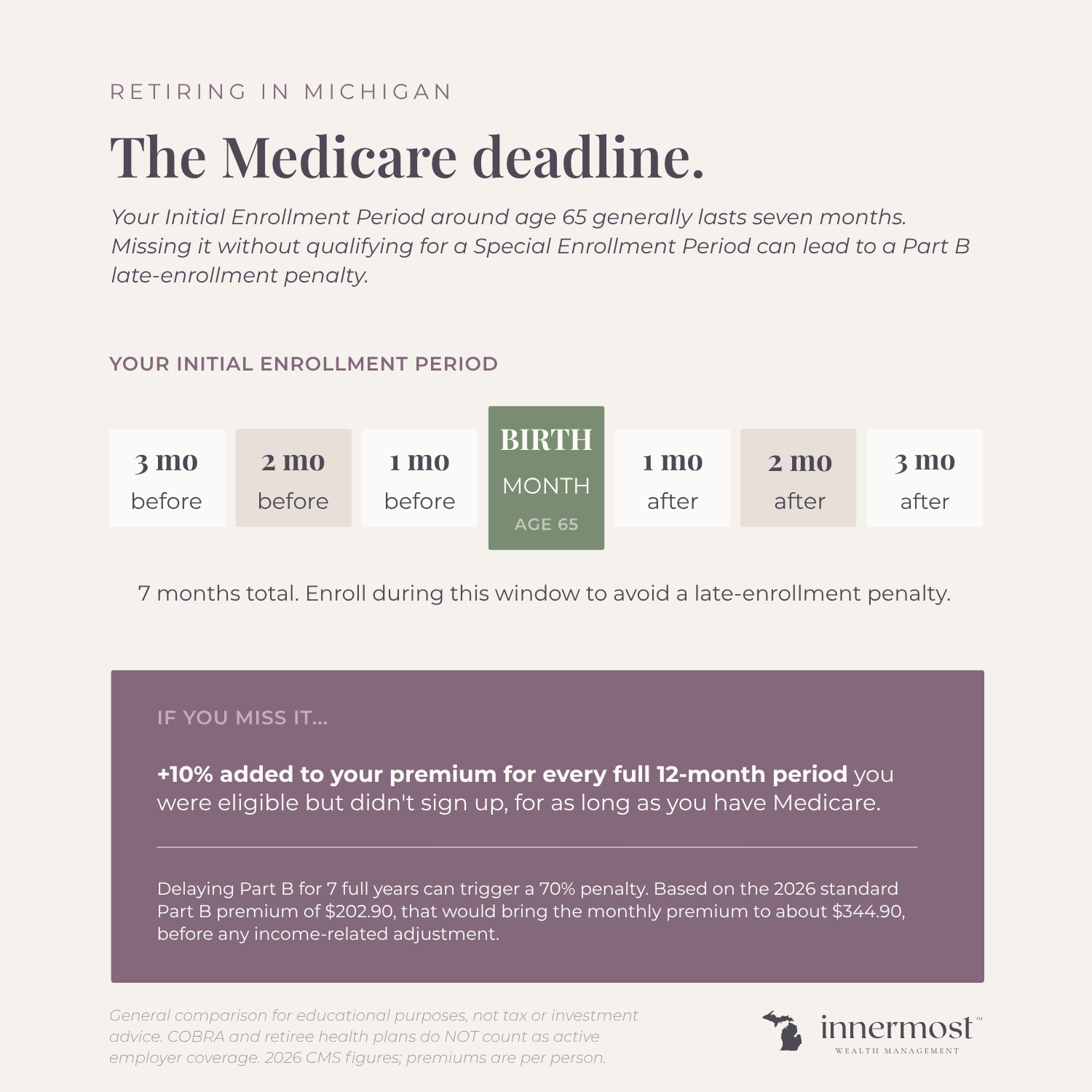
Understanding your Medicare Initial Enrollment Period (IEP) timeline (3 months before, the month of, and 3 months after your 65th birthday) is essential to avoiding long-term penalties. Delaying Medicare Part B without qualifying active employer coverage can result in an ongoing 10% premium penalty for every full 12-month period missed.
Working after 65 changes the analysis.
You do not necessarily need to enroll in every part of Medicare simply because you turn 65.
If you or your spouse are still actively working and you are covered through a qualifying employer group health plan, you may be able to delay Part B and use a Special Enrollment Period later.
Employer size and the way the health plan coordinates with Medicare matter. Medicare warns that coverage through an employer with fewer than 20 employees may not pay properly if you do not have both Part A and Part B. Confirm the coordination rules with the employer’s benefits administrator rather than assuming the group plan remains primary.
COBRA and retiree health coverage should not be treated the same as coverage based on current employment.
The employment-based Part B Special Enrollment Period generally ends eight months after the employment or qualifying job-based coverage ends, whichever happens first. Choosing COBRA does not extend that eight-month deadline.
Coordinate Medicare with HSA contributions.
Once you are enrolled in Medicare, you are no longer eligible to contribute to a health savings account.
There is an additional complication for people who work beyond 65. If you enroll in premium-free Part A later, coverage can be retroactive for as many as six months, but no earlier than the month you first became eligible for Medicare.
Medicare therefore advises people with HSAs to coordinate the end of their contributions before retiring or applying for Medicare or Social Security benefits. Contributions made for months covered by retroactive Part A may be treated as excess contributions.
Because Medicare and HSA timing can depend on your specific dates, confirm the plan with your tax professional, benefits administrator, or Medicare before contributing or enrolling.
What to review.
☐ Mark your Initial Enrollment Period well before your 65th birthday
☐ If you plan to work past 65, confirm how the employer plan coordinates with Medicare
☐ Do not assume that COBRA or retiree coverage allows you to delay Part B indefinitely
☐ Coordinate HSA contributions before Medicare coverage begins
☐ Estimate premiums for Part B, Part D or Medicare Advantage, and any Medigap coverage you expect to carry
Build your retirement-income plan before you need it.
Michigan’s tax rules determine part of what you will keep in retirement. The next step is coordinating those rules with federal taxes, Medicare premiums, Social Security, and the accounts you will use to create income.
Map each income source.
Start by listing everything you expect to use:
Social Security
pensions
traditional IRAs
Roth IRAs
401(k)s and other employer plans
taxable investment accounts
rental or business income
annuities
cash reserves
Those dollars do not all receive the same tax treatment.
A withdrawal from a traditional IRA may create ordinary taxable income. Qualified Roth withdrawals generally do not. Selling investments in a taxable brokerage account may generate capital gains. Social Security has its own federal taxation rules.
Knowing what you own is different from knowing which account should fund each year of retirement.
Decide how you will use the accounts.
There is no universal retirement withdrawal order.
Automatically spending taxable assets first, then tax-deferred accounts, and then Roth accounts may work in some situations and be inefficient in others.
The years immediately after retirement can sometimes create opportunities to withdraw from a traditional IRA or complete partial Roth conversions before other income sources begin. A conversion can also increase federal income tax, affect Medicare IRMAA, and interact with capital gains, deductions, and other income.
Michigan’s 4.25% income tax rate is one input in that decision. Your federal tax bracket, future required minimum distributions, Medicare premiums, expected longevity, charitable plans, and whether you expect to remain in Michigan matter too.
The useful question is not simply:
“How do I pay the least tax this year?”
It is:
“Which decisions leave me in the strongest position over the rest of my life?”
Make Social Security part of the same decision.
Social Security retirement benefits can generally begin as early as age 62. Delaying a retirement benefit can increase the monthly amount up to age 70.
For people born in 1960 or later, claiming at age 62 can reduce the worker’s retirement benefit by as much as 30% compared with waiting until full retirement age. The reduction for early claiming is generally permanent.
The best claiming age cannot be determined from the benefit amount alone. Longevity, marital status, survivor benefits, other assets, taxes, and the amount of income you need from your portfolio all matter.
What to review.
☐ List each source of retirement income and its tax treatment
☐ Determine how much you expect to spend each year
☐ Build a withdrawal strategy rather than choosing accounts only as expenses arise
☐ Evaluate partial Roth conversions during lower-income years
☐ Make the Social Security claiming decision alongside the rest of your income plan
☐ Stress-test the plan for a long retirement, higher healthcare costs, inflation, and market declines
Review your estate plan before retirement.
For someone dying today, Michigan generally does not impose a state inheritance tax. The state’s old inheritance tax applies only when the person died on or before September 30, 1993. Michigan also does not currently collect a separate state estate tax, although federal estate-tax rules may still apply to sufficiently large estates.
Taxes are only one reason to revisit an estate plan.
Make sure the basic documents are current.
A Michigan estate plan commonly includes:
a will
a durable financial power of attorney
a patient advocate designation for healthcare decisions
a revocable living trust when appropriate
A trust does not accomplish much simply because it has been signed. Assets intended to pass through the trust generally need to be titled or otherwise coordinated with it appropriately.
An estate-planning attorney can determine which documents are appropriate, prepare them, and advise you about their legal effect.
Review beneficiary designations.
Retirement accounts, life insurance policies, and other accounts with beneficiary designations generally transfer according to those designations rather than the instructions in your will.
Review them after major changes such as marriage, divorce, a death in the family, the birth of a child or grandchild, or a significant change in your estate plan.
Make the plan usable.
Someone should know where to find the information they would need if you became incapacitated or died.
That does not mean handing over every password today. It does mean keeping an organized record of your accounts, insurance, estate documents, key professional contacts, and instructions for locating important information.
What to review.
☐ Review your will and powers of attorney with an estate-planning attorney
☐ Confirm whether your trust, if you have one, is properly funded
☐ Review beneficiaries on retirement accounts and insurance policies
☐ Make sure account titling is consistent with your estate plan
☐ Give a trusted person enough information to locate your documents and accounts in an emergency
Bring the decisions together before you retire.
By the time you leave work, you should be able to answer five questions:
Where will your retirement income come from each year?
How will those withdrawals affect Michigan taxes, federal taxes, and Medicare premiums?
If you are moving, what will the new property’s tax bill look like after uncapping?
What are your exact Medicare and HSA deadlines?
Do your estate documents, account titles, and beneficiary designations still reflect what you want?
None of these questions requires you to predict the next 30 years perfectly. You do need enough of a plan that your decisions are working together.
Retirement changes the job your money has to do. You have spent years accumulating it. Now it needs to support your spending, manage taxes, absorb uncertainty, provide flexibility, and eventually pass to the people or causes you care about.
That transition is worth planning before your last day of work.
If you are approaching retirement in Michigan and want help coordinating your retirement planning decisions, that is part of the work we do with clients at Innermost Wealth Management.
Frequently asked questions about retiring in Michigan.
-
Michigan is a financially friendly state to retire in for most people. The state does not tax Social Security benefits, fully exempts military pensions, and as of 2026 lets retirees deduct up to $67,610 (single) or $135,220 (joint) of pension and retirement income regardless of birth year. Michigan also has no estate or inheritance tax and a flat 4.25% income tax. Federal taxes and healthcare costs still require planning, but the state treatment is favorable.
-
Michigan taxes some retirement income, but with a large deduction. Social Security is fully exempt from Michigan tax for all retirees, and military pensions are exempt with no cap. For 2026, other pension and retirement account income can be deducted up to $67,610 for single filers and $135,220 for joint filers, regardless of birth year, after the completion of a four-year phase-out of the old birth-year tier system. Income above the deduction is taxed at Michigan's flat 4.25% rate.
-
You should sign up for Medicare during your Initial Enrollment Period, a seven-month window that begins three months before the month you turn 65 and ends three months after. Medicare rules are federal, so they're the same in Michigan as everywhere else. Missing this window can trigger permanent late-enrollment penalties added to your premiums for life, unless you qualify for a Special Enrollment Period, such as still having active employer coverage from an employer with 20 or more employees.
-
No, Michigan has no estate tax and no inheritance tax. Your heirs will not owe Michigan tax on an inheritance, regardless of the amount. However, large estates may still be subject to the federal estate tax, and beneficiaries may owe income tax on certain inherited assets like traditional retirement accounts. Having current estate documents and up-to-date beneficiary designations matters more in Michigan than state estate tax planning does.
-
Michigan retirees can access several property tax breaks. The Principal Residence Exemption removes 18 mills of school operating tax from a primary home for any owner-occupant. Income-eligible homeowners, with a more generous formula for seniors, may qualify for the Homestead Property Tax Credit, and lower-income older homeowners may defer summer taxes. Exact income limits and credit amounts change annually, so confirm current figures with the Michigan Department of Treasury.
-
There's no universal number, because it depends on your spending, your income sources, and your goals rather than the state itself. Michigan's relatively low cost of living and favorable retirement tax treatment can make a given amount of savings stretch further than in higher-tax states. The more useful question than a target number is whether your income plan covers your expenses, healthcare, and a long retirement, which is what a personalized financial plan is designed to answer.
This material is provided for general educational purposes and is not individualized investment, tax, legal, or Medicare advice. Tax laws, benefit rules, eligibility requirements, and dollar amounts may change. Individual situations vary. Confirm current figures with the Michigan Department of Treasury and Medicare.gov, and work with qualified professionals for your specific situation.
Sources:
Michigan Department of Treasury, Retirement and Pension Benefits and Public Act 4 of 2023 FAQ.
Michigan Department of Treasury, 4.25% Income Tax Rate for Individuals and Fiduciaries in the 2026 Tax Year.
Michigan Department of Treasury, Principal Residence Exemption, Changes in Ownership and Uncapping of Property, and Homestead Property Tax Credit guidance.
Medicare, When Can I Sign Up for Medicare?, Avoid Late Enrollment Penalties, COBRA Coverage, and Working Past 65.
Social Security Administration, At What Age Should I Start Receiving My Social Security Retirement Benefits?
Michigan Department of Treasury, Inheritance Tax Frequently Asked Questions.