
Retirement Taxes in Michigan: What Nobody Tells You Until It's Too Late

Catching the evening light along the Lake Michigan shoreline. Shot by Kimberly during a summer camping trip at Nordhouse Dunes, just outside of Ludington and Manistee.
Key Takeaways
Michigan’s retirement-income phase-in is fully implemented for 2026. Eligible taxpayers of any birth year may use the fully phased-in retirement-and-pension subtraction, subject to the applicable limits and qualification rules. Other calculation methods remain available and may produce a better result for some taxpayers.
Michigan does not tax Social Security benefits, but retirement taxes do not end there. Traditional retirement-account withdrawals, required minimum distributions, capital gains, Roth conversions, and other income can still affect federal taxes, Michigan taxes, the taxation of Social Security, and Medicare premiums.
Retirement tax planning works best when decisions are evaluated together. The timing of withdrawals, Roth conversions, Social Security, investment sales, charitable gifts, and other major income events can affect both your current tax bill and your flexibility later in retirement.
Most people spend decades preparing for retirement.
They contribute to retirement accounts, build investment portfolios, accumulate company stock, grow businesses, and save consistently throughout their careers.
As retirement approaches, the questions begin to change. Instead of focusing primarily on how to build and accumulate wealth, the focus shifts to how and when to use it.
Which accounts should you draw from first?
What happens when required minimum distributions begin?
Should you complete Roth conversions?
When should you sell concentrated stock or other appreciated investments?
How much of your retirement income will Michigan tax?
And why might your overall tax bill remain higher than you expected after you stop working?
Many people assume their taxes will decline automatically when they retire. What often surprises them is that retirement changes where taxable income comes from, not necessarily how much tax planning is required.
Traditional retirement accounts, appreciated brokerage investments, employer stock, real estate, and business interests can all continue to create tax consequences after you leave work. Decisions about when to withdraw money, sell investments, claim Social Security, or complete a Roth conversion can affect more than one tax year.
Michigan’s retirement tax rules create meaningful planning opportunities, but they are only one part of the picture. Federal taxes, required minimum distributions, investment income, Medicare premiums, and the timing of major financial decisions all affect how much you may pay throughout retirement.
This article explains how retirement income is taxed in Michigan, where federal rules continue to matter, and which planning decisions deserve attention before and during retirement.
Does Michigan tax Social Security benefits?
Michigan does not tax Social Security benefits.
If Social Security income is included in your federal adjusted gross income, Michigan generally allows it to be subtracted when calculating state taxable income.
Federal treatment is different. Depending on your overall income, as much as 85% of your Social Security benefits may be included in federal taxable income.
Traditional IRA and 401(k) withdrawals, pensions, investment income, capital gains, rental income, and other taxable income can all affect how much of your Social Security becomes federally taxable.
That is one reason the Social Security claiming decision should not be made in isolation.
The age at which you claim affects the size of your benefit, but the timing also interacts with:
retirement-account withdrawals
Roth conversions
pension income
investment sales
required minimum distributions
Medicare premiums
the income your portfolio needs to produce
The strongest claiming strategy is generally the one that fits into the rest of your retirement-income plan—not simply the one that produces the largest or smallest tax bill in a single year.
Michigan retirement-and-pension income tax rules.
Under the Lowering MI Costs Act, Michigan gradually expanded its retirement-and-pension subtraction over four years.
Beginning with the 2026 tax year, the phase-in method reaches 100% and is available regardless of birth year. Under this method, eligible taxpayers may subtract qualifying public and private retirement income up to the annual limit.
For 2026, the maximum subtraction under the fully phased-in method is:
$67,610 for a single return
$135,220 for a joint return
Those amounts are adjusted over time.
The fully phased-in method does not mean every retirement distribution is automatically excluded from Michigan taxable income. The type of income, the taxpayer’s age, the distribution code, and other qualification requirements can affect whether a payment is eligible.
Michigan also retains other retirement-income calculation methods.
Depending on your circumstances, you may be eligible to use:
the original birth-year-based retirement rules
the fully phased-in retirement-and-pension subtraction
a separate subtraction for certain qualifying public-safety retirement benefits
the military retirement subtraction
other applicable Michigan deductions
The best calculation depends on your age, income sources, and eligibility. The fully phased-in method may be the simplest or most favorable option for many taxpayers, but it should not be assumed to be the best method for everyone.
Military and qualifying public-safety retirement benefits.
Qualifying military retirement and survivor benefits generally remain fully deductible from Michigan taxable income without being subject to the standard retirement-subtraction limit.
Certain qualifying retired police officers, firefighters, corrections officers, and other eligible public-safety employees may also qualify for special treatment of eligible retirement income.
The definitions and qualification rules matter. A person’s job title alone does not necessarily establish eligibility, so confirm the treatment using current Michigan guidance or with a qualified tax professional.
A 2026 change for certain taxpayers age 67 or older.
Public Act 24 of 2025 created another change for tax years 2026 through 2028.
Certain Michigan taxpayers born after 1952 who are at least age 67 may claim both the Michigan standard deduction and the Social Security subtraction. Previously, the standard deduction was reduced by the amount of Social Security deducted.
The standard deduction remains subject to the applicable rules, including a reduction for personal exemptions.
For someone with multiple sources of retirement income, comparing the available Michigan calculations may produce a meaningfully different result.
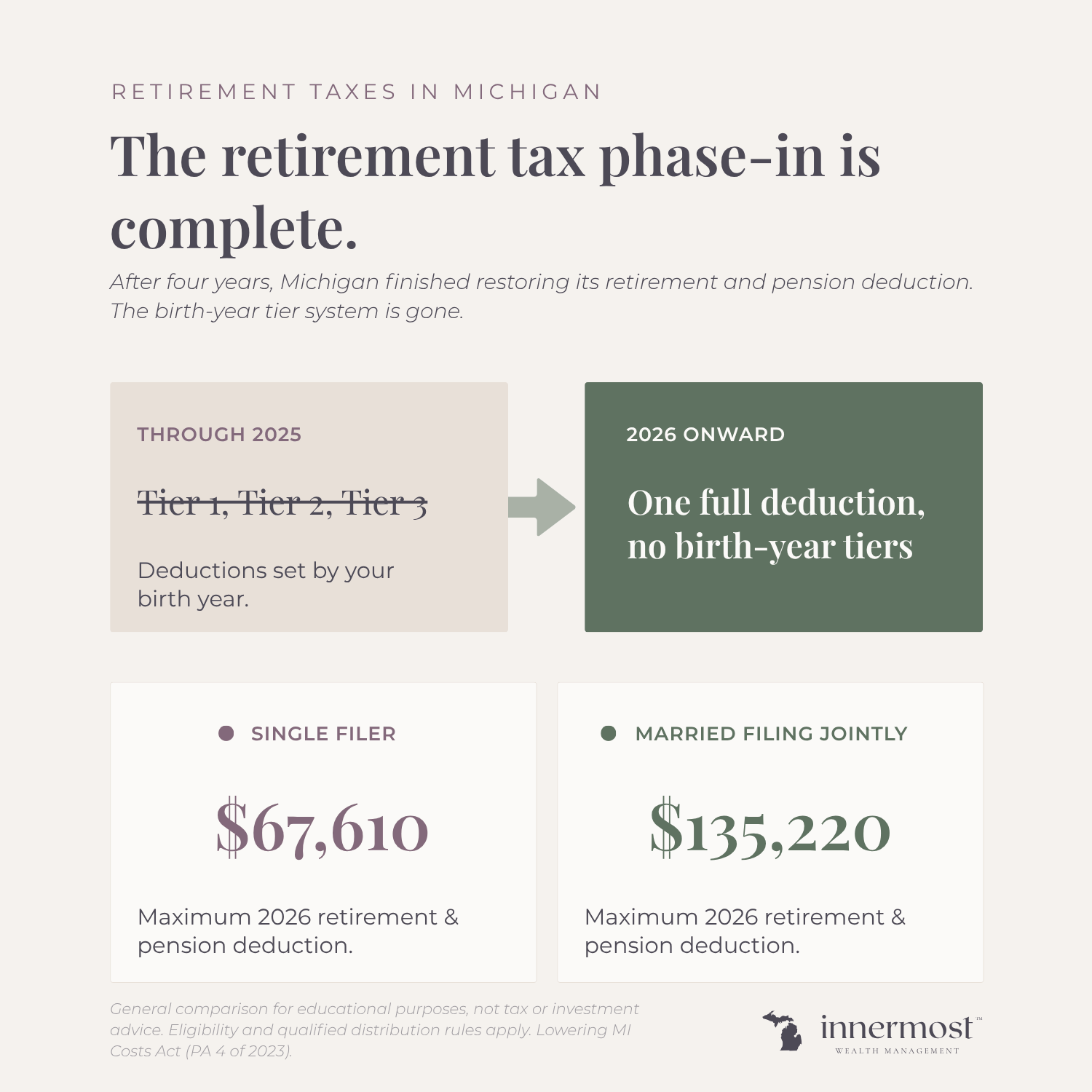
Michigan's four-year phase-in is finished. Starting in 2026, the old birth-year tiers are gone and eligible retirees get one full retirement and pension deduction.
How traditional retirement-account withdrawals are taxed.
For many years, maximizing pretax retirement accounts was sound advice.
Contributing to a traditional 401(k) or deductible IRA reduced taxable income during working years and allowed investments to grow tax-deferred. For many people, particularly those saving during their highest-earning years, that was an appropriate strategy.
Many of today’s retirees also spent much of their careers without access to a Roth 401(k). Roth 401(k)s first became available in 2006, and employer adoption took time.
As a result, it is common for someone approaching retirement to have most—or nearly all—of their retirement savings in traditional tax-deferred accounts.
A traditional 401(k) or IRA balance is not the same as an equal amount available to spend.
If you have $1 million in a traditional retirement account, part of that balance represents future taxes. The amount you ultimately keep depends on:
how much you withdraw each year
your federal tax bracket
whether the withdrawal qualifies for a Michigan subtraction
your other taxable income
the taxation of Social Security
Medicare IRMAA
deductions and credits available to you
future changes in tax law
Traditional IRA and 401(k) withdrawals are generally included in federal taxable income as ordinary income.
For Michigan purposes, a qualifying distribution may be partially or fully subtracted, depending on the retirement-income method available to you, the applicable limit, and the other income included in the calculation.
If a large portion of your wealth is held in traditional retirement accounts, your future tax flexibility may be more limited than the account balance alone suggests.
Having money across taxable, tax-deferred, and Roth accounts can provide more flexibility when deciding where retirement income should come from each year.
How required minimum distributions affect retirement taxes.
Required minimum distributions eventually require money to come out of traditional IRAs and most tax-deferred employer retirement plans, whether or not you need the distribution for spending.
The applicable starting age depends on your birth year and the law in effect. Under current federal law, many retirees begin RMDs at age 73, while people born in 1960 or later generally begin at age 75.
RMDs are generally included in federal adjusted gross income, except for any applicable after-tax basis.
That income can affect more than the tax due on the distribution itself. A larger RMD may:
increase the federally taxable portion of Social Security
move part of your income into a higher federal tax bracket
increase Medicare premiums through IRMAA
affect net investment income tax exposure
reduce the value of certain deductions or credits
limit your ability to recognize other income at a lower tax rate
Michigan may allow some or all of a qualifying RMD to be subtracted under an available retirement-income calculation, but the distribution still enters the federal tax and Medicare calculations.
The first RMD requires special attention.
Your first required minimum distribution may generally be delayed until April 1 of the following year.
Delaying it does not eliminate the distribution. It can result in two RMDs being taken during the same calendar year: the delayed first RMD and the regular RMD for the second year.
That may increase taxable income and potentially affect Medicare premiums or other tax calculations.
Taking the first distribution during the initial RMD year may sometimes produce a better result, even when the law permits a delay.
Roth accounts and RMDs.
Under current law, Roth IRAs are not subject to lifetime RMDs for the original owner.
Designated Roth accounts in employer plans, including Roth 401(k)s and Roth 403(b)s, are also no longer subject to lifetime RMDs for the original owner.
That can make Roth assets valuable not only because qualified withdrawals are tax-free, but also because the owner generally is not forced to withdraw them on a prescribed schedule.
Roth accounts and tax-free retirement income.
Qualified withdrawals from Roth IRAs and Roth employer accounts are generally excluded from federal taxable income.
Because Michigan begins its calculation with federal adjusted gross income, qualified Roth withdrawals are generally not taxable by Michigan either.
Qualified Roth distributions also generally do not increase the modified adjusted gross income used to calculate Medicare IRMAA.
That can make Roth assets a flexible source of income during years when taking additional taxable income from a traditional account would create an unwanted tax or Medicare consequence.
How Roth conversions are taxed in Michigan.
A Roth conversion moves money from a traditional retirement account into a Roth account.
The converted amount generally creates federal taxable income in the year of the conversion. Because Michigan begins with federal adjusted gross income, the amount is initially included in Michigan income as well.
However, a conversion completed at age 59½ or later may qualify for Michigan’s retirement-and-pension subtraction, subject to the applicable limits and eligibility requirements.
That means the federal and Michigan consequences of the same conversion may differ.
A Roth conversion may be worth evaluating during a lower-income period, such as:
after retirement but before Social Security begins
before required minimum distributions start
during a temporary career break
after a business-income decline
in a year with unusually large deductions
before a surviving spouse may face single-filer tax and IRMAA thresholds
The conversion itself is not automatically beneficial. It requires paying tax earlier in exchange for the possibility of tax-free growth and qualified withdrawals later.
The analysis should consider:
your current federal and Michigan tax rates
your expected future tax rates
the cash available to pay the tax
your projected RMDs
Social Security timing
Medicare IRMAA
estate-planning goals
how long the Roth assets may remain invested
whether the conversion qualifies for a Michigan subtraction
A personal example.
I converted part of my own traditional IRA during the first year I was building Innermost Wealth Management.
My income was lower than it had been previously, so I estimated the federal and Michigan tax impact, set aside cash for the tax, and completed the conversion.
Given my income and circumstances that year, I determined that it was an appropriate time for me to convert.
That does not mean the same decision would be appropriate for someone else. Age, income, available cash, Medicare exposure, investment horizon, and Michigan’s retirement subtraction can all change the result.
Michigan tax on investment income.
Taxable brokerage accounts can be an important source of retirement income because they generally offer more flexibility than traditional retirement accounts.
They are not subject to required minimum distributions, and you usually have more control over when to sell investments and recognize taxable income.
At the Michigan level, investment income is generally subject to the state’s flat 4.25% individual income-tax rate.
That generally includes:
taxable interest
dividends
short-term capital gains
long-term capital gains
Michigan does not provide a separate preferential rate for long-term capital gains like the federal government does.
Some Michigan residents born before 1946 may qualify for an investment-income subtraction, although the available amount can be affected by retirement-benefit deductions claimed during the same year.
Federal taxation is more complex.
Long-term capital gains and qualified dividends may receive preferential federal rates, but investment income can also affect:
the net investment income tax
the taxation of Social Security
Medicare IRMAA
capital-gain brackets
deductions and credits tied to income
the taxation of other financial events occurring during the same year
This becomes especially important when you own concentrated company stock, highly appreciated investments, inherited assets, real estate, or a business interest.
The question is not only how much tax a sale creates this year. It is also how the sale fits with the rest of your retirement income.
Holding assets across taxable, tax-deferred, and Roth accounts can give you more flexibility in managing taxable income from year to year.
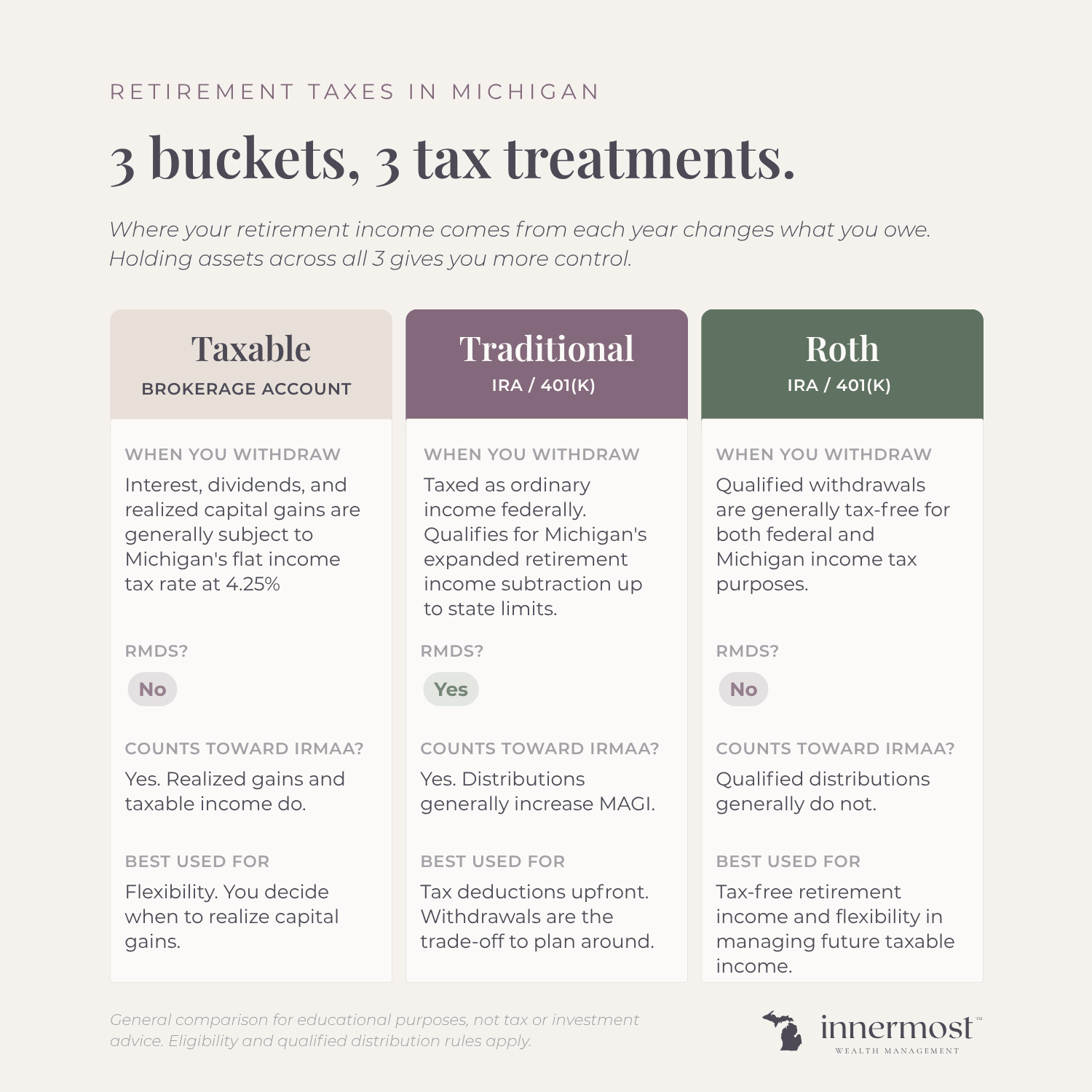
Where your retirement income comes from each year changes what you owe. Holding assets across all three account types gives you more control over your tax bill.
Michigan property taxes still belong in the retirement plan.
Property taxes are not income taxes, but they can have a meaningful effect on retirement cash flow.
Michigan generally limits annual increases in a property’s taxable value to the lesser of inflation or 5% while the property remains under the same ownership, subject to additions and other adjustments.
After a qualifying transfer of ownership, the taxable value generally uncaps in the following calendar year.
That means the seller’s current property-tax bill may not be a reliable estimate of what you will pay after buying the home.
A less expensive home also does not necessarily produce a proportionately lower property-tax bill, particularly if you are moving from a property with a long-capped taxable value to one that will uncap after purchase.
Michigan’s Principal Residence Exemption exempts a qualifying primary residence from up to 18 mills of local school operating tax. A second home or vacation property generally does not qualify.
Before moving or buying a second home in retirement, estimate the post-uncapping property taxes and include them in your long-term cash-flow plan.
For a more complete discussion, see our guide to what to know before retiring in Michigan.
What is IRMAA, and how does it affect retirement income?
IRMAA stands for Income-Related Monthly Adjustment Amount.
It is an additional amount charged on Medicare Part B and Part D when modified adjusted gross income exceeds specified thresholds. IRMAA is a federal rule and applies to Medicare beneficiaries in Michigan in the same way it applies elsewhere in the United States.
For IRMAA purposes, modified adjusted gross income is generally:
Adjusted gross income + tax-exempt interest
Medicare usually uses income reported on your federal tax return from two years earlier.
For 2026 Medicare premiums, Social Security generally looks at your 2024 tax return.
That delay can catch retirees by surprise.
A Roth conversion, business sale, large capital gain, or retirement-account withdrawal in 2024 may increase Medicare premiums in 2026, even though the financial event happened two years earlier.
The 2026 standard premium and thresholds.
For 2026, the standard Medicare Part B premium is $202.90 per month.
Individuals with 2024 modified adjusted gross income of $109,000 or less and married couples filing jointly with income of $218,000 or less generally pay the standard Part B premium and do not owe a Part D IRMAA surcharge.
At higher income levels, both Part B premiums and Part D surcharges increase.
At the highest 2026 level:
single filers with 2024 MAGI of $500,000 or more
married couples filing jointly with 2024 MAGI of $750,000 or more
generally pay $689.90 per month for Part B, plus a $91 monthly Part D IRMAA surcharge in addition to the premium charged by their chosen Part D plan.
These thresholds and premium amounts can change each year, so current CMS and Social Security guidance should always be checked before making a decision.
IRMAA uses bracket thresholds.
IRMAA is not gradually phased in one dollar at a time.
Crossing a threshold can move the beneficiary into the next premium level for the coverage year. If both spouses are enrolled in Medicare, the household may pay the higher amount twice.
That does not mean you should avoid every transaction that crosses a threshold. A Roth conversion or investment sale may still be beneficial.
It means the Medicare impact should be included in the analysis rather than discovered afterward.
A better question is:
Does the long-term benefit of this decision justify the federal tax, Michigan tax, and Medicare costs it creates?
IRMAA is recalculated.
An IRMAA surcharge is not necessarily permanent.
Medicare premiums are recalculated for each coverage year using the income information available to Social Security. If your income falls in a later year, your IRMAA may also decline after the applicable lookback period.
Appealing IRMAA after a life-changing event.
If your income has declined because of a qualifying life-changing event, you may ask Social Security to use more recent income information.
Examples of qualifying events can include:
marriage
divorce or annulment
death of a spouse
stopping work
reducing work
loss of income-producing property
loss of certain pension income
an employer settlement payment
The request is generally made using Form SSA-44 with supporting documentation.
Submitting the form does not guarantee that the adjustment will be approved. The result depends on whether the event qualifies and whether the documentation supports the lower income estimate.
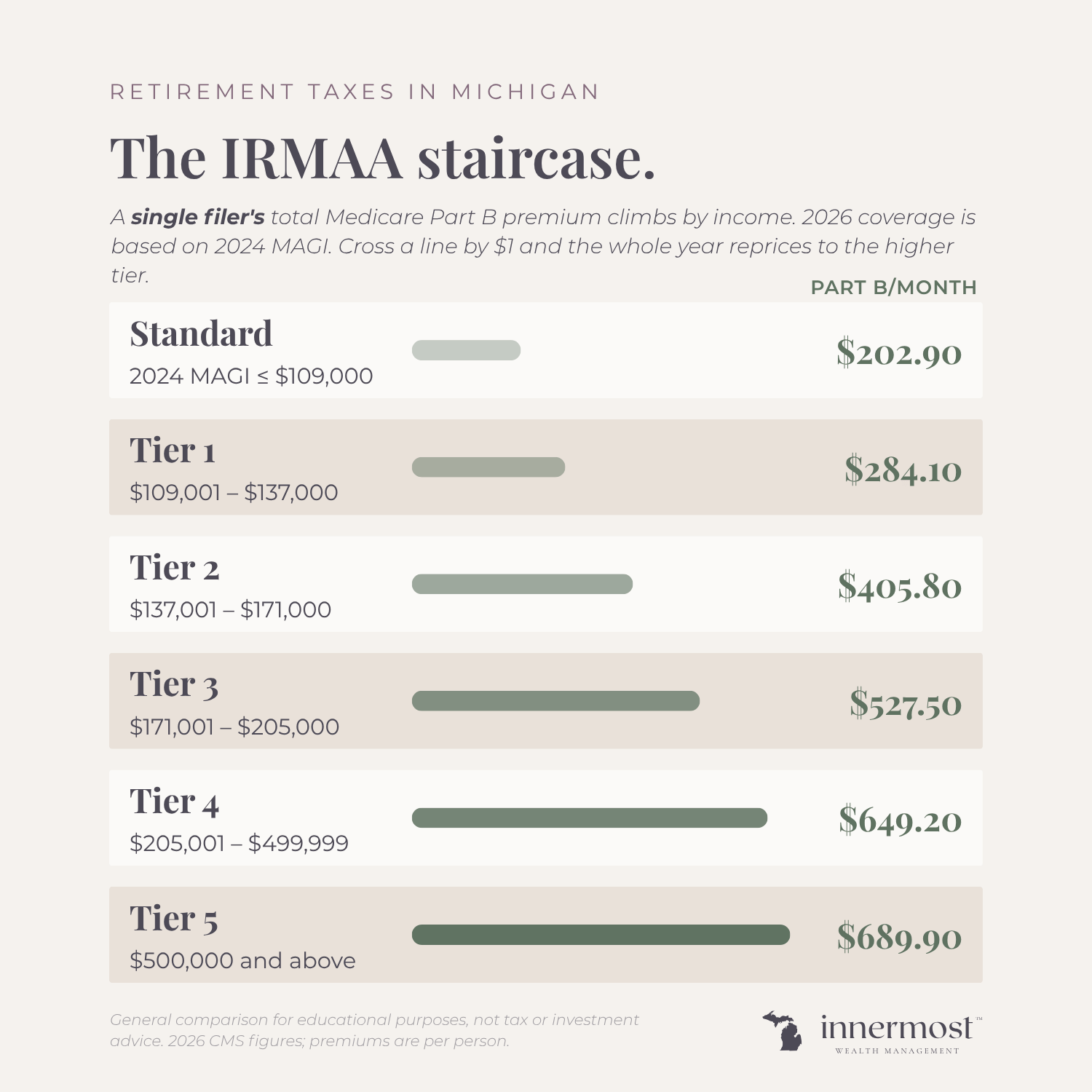
For single filers, the total Medicare Part B premium climbs with income. Cross a bracket line by even one dollar and the whole year reprices to the higher tier.
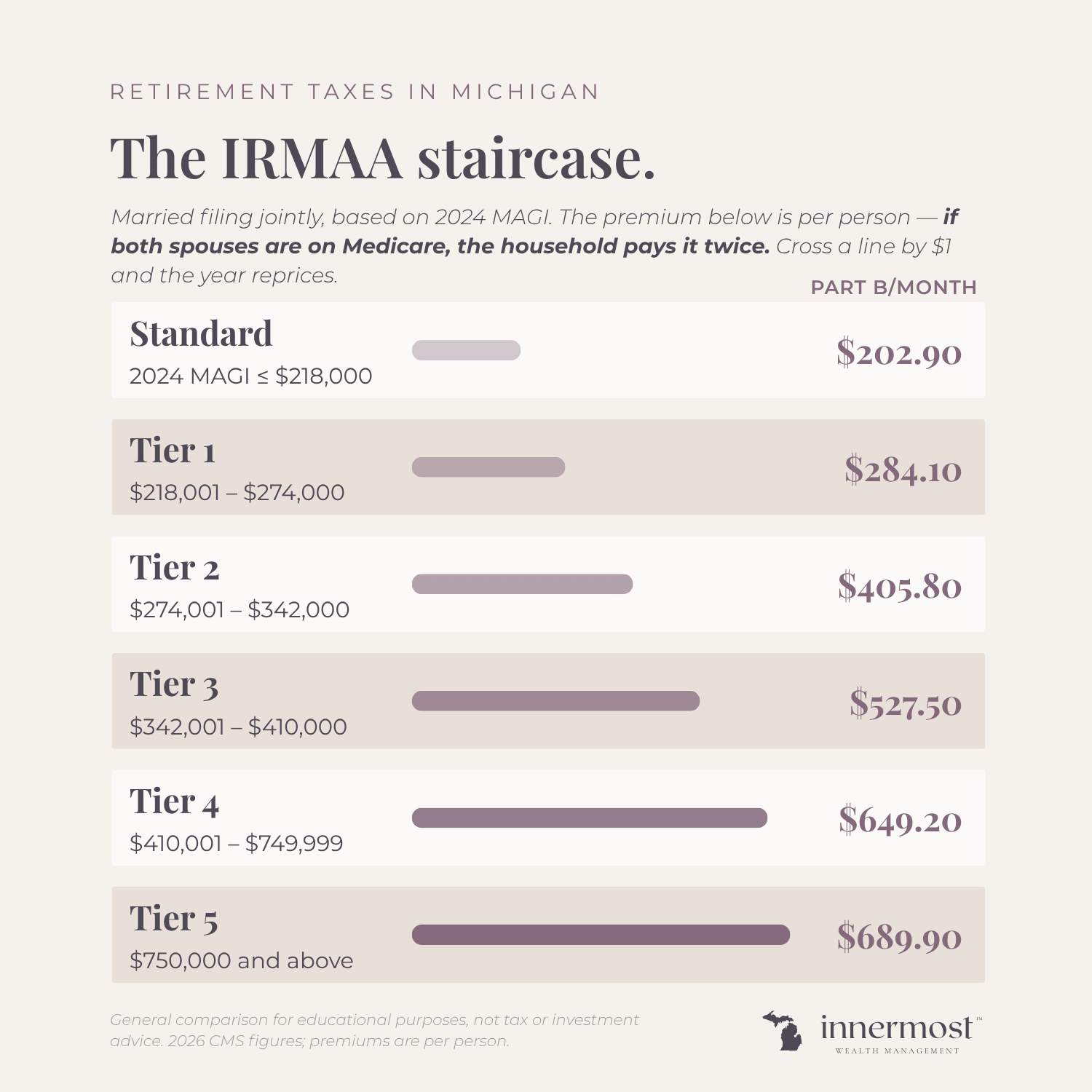
For married couples, the premium shown is per person — if both spouses are on Medicare, the household pays it twice. One dollar over a line reprices the year for both.
What happens to Medicare costs after a spouse dies?
IRMAA can become especially important after the death of a spouse.
The thresholds for single filers are generally about half the thresholds for married couples filing jointly. But the surviving spouse’s taxable income may not fall by half.
The survivor may still receive:
pension income
required minimum distributions
investment income
rental or business income
a portion of the couple’s Social Security
income from inherited retirement accounts
As a result, a surviving spouse can move into a higher Medicare premium level even when total household income has declined.
The same issue can affect federal income taxes because the surviving spouse will eventually move from married-filing-jointly tax brackets to single-filer brackets.
Tax diversification can provide more flexibility.
Qualified Roth distributions generally do not increase the MAGI used for IRMAA, while traditional retirement-account distributions generally do.
Building Roth assets while both spouses are alive is one possible strategy for giving the surviving spouse more control over future taxable income. It is not a universal solution, and the cost of creating those Roth assets should be evaluated before completing conversions.
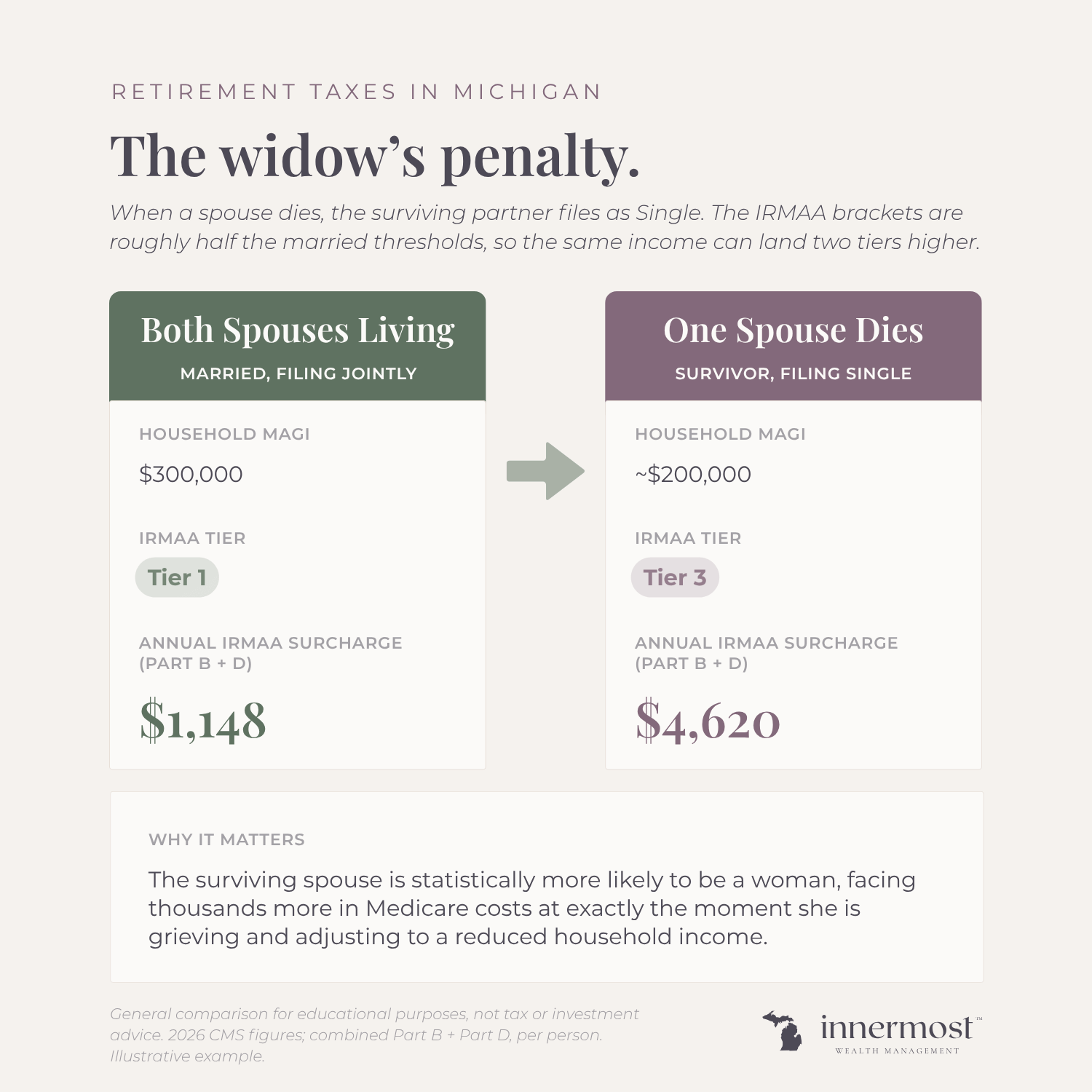
Losing a spouse means transitioning to single tax brackets, where IRMAA thresholds cut roughly in half. As shown above, even with reduced overall household income, a surviving spouse may jump multiple IRMAA tiers and face thousands more in annual Medicare costs.
Coordinate major income events across tax years.
Large tax bills in retirement are often created by several reasonable decisions happening during the same year.
Someone might:
sell a business
sell real estate
take a large IRA distribution
complete a Roth conversion
sell a concentrated stock position
realize capital gains
begin a pension
claim Social Security
exercise stock options
Each decision may make sense on its own.
Together, they may create a much larger federal tax bill, use more of the Michigan retirement subtraction, increase the taxation of Social Security, trigger net investment income tax, or raise future Medicare premiums.
Coordinating the decisions across multiple tax years may create a better result.
That can include:
spreading income over several years
completing partial rather than full Roth conversions
selling appreciated investments gradually
pairing gains with available losses
coordinating charitable gifts with high-income years
using qualified charitable distributions after eligibility begins
delaying or accelerating a transaction based on the rest of the income plan
selecting retirement-account withdrawals intentionally rather than reactively
The objective is not simply to pay the least tax this year.
It is to make decisions that leave you in the strongest position throughout retirement.
The emotional side of retirement tax planning.
Retirement planning is not only a tax exercise.
For decades, the focus is on saving, investing, delaying gratification, and preparing for the future. Those habits are rewarded throughout your working years.
Retirement asks you to do something different.
Instead of accumulating wealth, you are expected to begin using it.
For some people, that transition feels natural. For others, it is surprisingly difficult—even when the financial plan shows they can afford to retire.
Someone can have enough to support the life they want and still feel guilty about spending, worry about running out, or treat every purchase as though they are still in their peak accumulation years.
I see this particularly with women who have spent decades managing households, raising families, building careers or businesses, and putting other people’s needs ahead of their own.
They may be comfortable making financial decisions for everyone else but much less comfortable making choices that benefit themselves.
That is one reason retirement planning should account for more than taxes, investments, and withdrawal strategies.
A financial plan can help you understand what your wealth can support and give you greater confidence in using it intentionally.
If this part of retirement resonates with you, our article on the emotional transition into retirement explores it in more depth.
Retirement tax planning in a nutshell.
Retirement tax planning is the process of making informed decisions about when and how income is recognized throughout retirement.
That includes decisions involving:
retirement-account withdrawals
required minimum distributions
Social Security
pension income
investment sales
Roth conversions
Medicare premiums
charitable giving
real estate
business interests
estate and legacy goals
No single withdrawal order or tax strategy works for everyone.
The right approach depends on your income sources, assets, goals, tax exposure, family circumstances, and the rules in effect at the time.
Michigan’s retirement-income rules may create valuable opportunities, but they are only one piece of a larger retirement-income plan.
If you are approaching retirement or are already retired and would like help coordinating a tax-aware retirement-income strategy, I would be glad to help.
Frequently asked questions about retirement taxes in Michigan.
-
Michigan may tax some retirement income, but eligible taxpayers can use one of several available subtraction methods. Beginning in 2026, the fully phased-in retirement-and-pension subtraction is available regardless of birth year, with a maximum of $67,610 for a single return and $135,220 for a joint return. Qualification rules and other available methods can affect the final result.
-
No. Michigan generally allows Social Security benefits included in federal adjusted gross income to be subtracted when calculating Michigan taxable income. Social Security may still be federally taxable depending on your other income.
-
Traditional retirement-account withdrawals are generally included in federal adjusted gross income. Michigan may allow some or all of an eligible distribution to be subtracted, depending on your age, the type of distribution, the calculation method used, and the annual limits.
-
A Roth conversion is generally included in federal adjusted gross income and initially enters the Michigan income calculation. If the conversion occurs at age 59½ or later, it may qualify for Michigan’s retirement-and-pension subtraction, subject to the applicable requirements and limits.
-
Possibly, but the decision depends on your current and expected future tax rates, available cash, projected RMDs, Social Security timing, Medicare exposure, investment horizon, and Michigan tax treatment. A conversion should be evaluated as part of the full retirement-income plan.
-
IRMAA is an additional amount charged on Medicare Part B and Part D when modified adjusted gross income exceeds specified thresholds. Medicare generally uses income from two years earlier, so a large income event can affect premiums later.
-
Qualified Roth IRA distributions generally are not included in adjusted gross income and therefore ordinarily do not increase the MAGI used for IRMAA. Nonqualified distributions or other Roth-related transactions may receive different treatment.
-
Michigan provides favorable treatment for Social Security, qualifying military retirement benefits, and eligible retirement-and-pension income. However, federal taxes, Medicare premiums, investment income, property taxes, and the taxpayer’s specific income sources still affect the overall result.
This article is provided for general educational purposes and does not constitute individualized investment, tax, legal, Medicare, or financial advice. Michigan and federal tax laws, Medicare rules, thresholds, and premiums may change, and individual circumstances vary. Consult a qualified tax, legal, Medicare, or financial professional regarding your situation.
Sources
Michigan Department of Treasury — Retirement and Pension Benefits https://www.michigan.gov/taxes/iit/tax-guidance/tax-situations/retirement-and-pension-benefits
Michigan Revenue Administrative Bulletin 2026-1 https://www.michigan.gov/taxes/rep-legal/rab/2026-revenue-administrative-bulletins/revenue-administrative-bulletin-2026-1
Michigan Public Act 24 of 2025 https://legislature.mi.gov/documents/2025-2026/publicact/htm/2025-PA-0024.htm
Michigan 2026 Income Tax Rate Confirmation — State Treasurer's Office https://content.govdelivery.com/attachments/MITREAS/2026/04/15/file_attachments/3619120/FY%202026%20Income%20Tax%20Rate%20Letter.pdf
CMS 2026 Medicare Parts A & B Premiums and Deductibles https://www.cms.gov