
The Emotional Stages of Retirement: What to Expect Financially and Personally

Key Takeaways
The balance-sheet illusion: retirement is a financial milestone and a major identity transition. Many high earners spend decades perfecting their portfolios while barely preparing for the psychological shift that follows.
Build the life before you leave: retirement won't dissolve burnout or hand you instant purpose. The people who do best tend to nurture community, health, and interests long before they step away.
Accumulation to stewardship: as you age, the money question shifts from "How much more can I build?" to "How do I use what I've built thoughtfully?" — and that calls for a different approach to your assets.
For decades, retirement has been sold as the ultimate reward. Work hard, save aggressively, push through the stress, delay gratification, and then one day you retire and finally begin living.
That story has always felt incomplete to me, and for many high earners it backfires. It encourages people to tolerate lives they deeply dislike for years, while pinning all their future happiness on a date circled on a calendar.
I've worked with people who genuinely love their careers and keep working because the work gives them purpose, community, and intellectual stimulation. I've worked with people who are burned out and counting down the days. I've worked with couples who retire years apart because they're simply not ready, emotionally or financially, to stop at the same time. And I've worked with people who retire, feel immediate relief, spend a few months decompressing, and then land on a harder question: now what?
That question usually shows up after the pace slows down, once the travel eases off, the house projects are finished, and the novelty of sleeping in has worn off. For people whose identity has been tied to achievement, productivity, income, or status, it can feel surprisingly destabilizing.
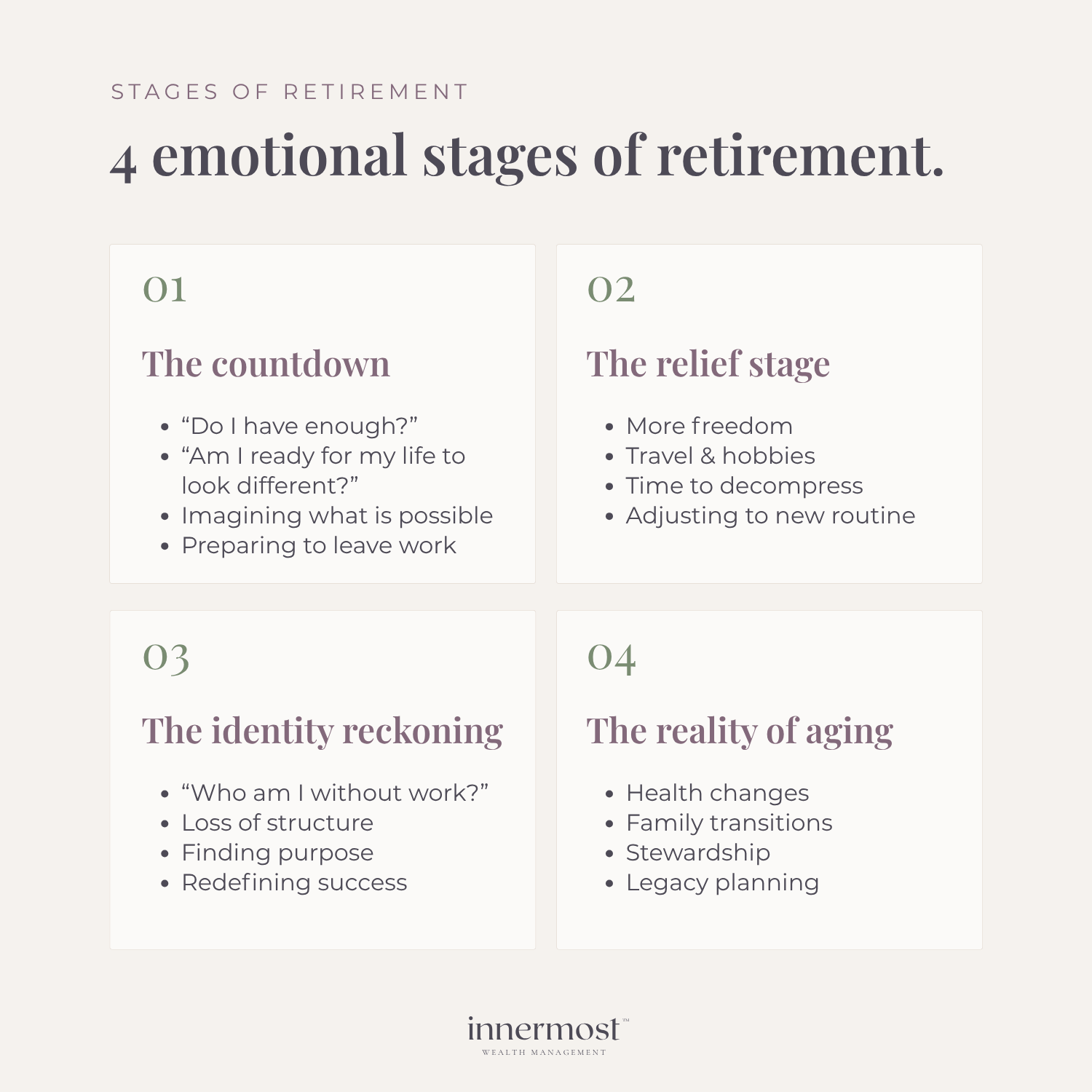
Retirement is usually framed as a financial milestone. It's also an identity transition, and most people spend far more time preparing their portfolio than preparing themselves. What follows are the four emotional stages of retirement I've seen play out again and again in my work, and how to prepare for each one, financially and personally.
Phase One: The Countdown
This phase often begins years before retirement, and it usually starts with spreadsheets, calculators, and logistical questions. Can we retire? Should we? Do we have enough? Should I work one more year? When should we take Social Security? What happens with healthcare, and how do we replace the income?
These are important questions. But there's usually another one underneath all of them: am I ready for my life to look different?
The answer depends on your work, your health, your finances, and your temperament. Some people love their work; some are deeply unhappy in it. Some are hanging on out of fear, and some are being pushed out through layoffs, restructuring, health issues, or caregiving. Some have far more than enough and still struggle to stop, because saving itself became part of who they are. Others genuinely need to keep working longer.
This is why I dislike blanket retirement advice. "Retire as early as you can" and "work one more year" both ignore the circumstances that actually matter. Your health, household, finances, relationship with work, and what you want your life to look like all belong in the decision. Financial planning can help you understand the tradeoff between enjoying more of your money and time today and preserving enough flexibility for later. There isn't one right balance for everyone.
It's also worth planning for the possibility that retirement happens earlier than you expect. Health changes, layoffs, caregiving responsibilities, and corporate restructuring can all change the timeline.
Phase Two: The Relief Stage
This is the honeymoon phase, and it can be wonderful. People sleep, travel, exercise, spend more time with family, take the long trip they've been putting off, catch up on the house, or do absolutely nothing for a while. After a demanding career, most people need that. After a demanding career, it can take time to decompress.
I've seen retirees feel enormous relief in this stage, especially those leaving high-pressure roles. But it has its own challenges. Spending can climb quickly when retirement feels like a permanent vacation. One spouse may want to travel constantly while the other wants a slower pace. And people often realize they were far more exhausted than they ever admitted while working. This phase can be joyful. It can also be revealing.
Phase Three: The Identity Reckoning
By this stage the novelty has worn off, and the deeper questions show up. Who am I without my title? Without my productivity? Why do I feel restless, or struggle to enjoy this, or suddenly feel irrelevant?
This tends to hit high achievers hardest — executives, business owners, professionals whose sense of self grew tightly around their work. It reminds me a little of athletes who train their whole lives toward one thing and then stop; without something meaningful beyond the performance, it's easy to feel untethered and unsure who you are outside of it. That's a large part of why I believe building a life you enjoy before retirement matters so much.
I'll be honest that this one is personal for me. Earlier in my career, I worked in financial environments that felt deeply misaligned — places where the culture, the priorities, and how people, especially women, were treated left me exhausted. Back then I was hyper-focused on saving aggressively, because financial freedom felt like an escape hatch. I wanted protection. I wanted optionality. I wanted out.
Owning my own firm shifted that. I still care deeply about saving and financial independence, obviously, but I'm no longer sprinting away from something. I'm building toward work I actually believe in, work that aligns with my values and makes a real difference, and I wake up grateful for it. Because of that, I hope to keep doing this for as long as I can. My own vision of retirement has changed. I see younger generations pushing back on the work-until-you-drop model, and I think that's healthy. We go deeper on this in why retirement isn't about stopping work, but about choice.
Purpose shouldn't suddenly materialize on your 65th birthday. It should be woven throughout your entire journey.
“Purpose shouldn’t suddenly materialize on your 65th birthday. It should be woven throughout your entire journey.”
Phase Four: The Reality of Aging
This phase tends to arrive gradually, and sometimes all at once. A parent gets sick. An adult child needs financial help. A spouse develops health concerns. Long-term care enters the conversation, estate planning becomes more urgent, and you may begin losing friends, or a spouse. Slowly, the focus shifts from accumulation to stewardship — from "How much more can I build?" to "How do I use what I've built thoughtfully?"
That shift often reshapes what wealth even means to a person. It's why our investment management approach moves from pure accumulation toward intentional stewardship as clients enter this season. For some families it becomes a time of real generosity: helping children earlier, funding education for grandchildren, traveling while health allows, giving intentionally, and protecting a surviving spouse. For others it feels heavy. But it often brings extraordinary perspective, too. People tend to get much clearer on what matters when time starts to feel finite.
Retirement Was Never Meant to Carry the Full Weight of Your Happiness
That's an enormous amount of pressure to place on a single chapter of life, and it's one reason so many people feel disoriented when they finally arrive. They spent decades working, saving, and waiting for life to begin, and then retirement comes and they discover they still need purpose, connection, health, meaning — and a financial plan that supports all of it.
The healthiest retirements I've seen rarely belong to the people who spent their lives sprinting toward an escape hatch. They belong to the people who built meaningful lives long before retirement arrived: who kept up relationships and a sense of community, developed interests and goals outside of work, protected their health, built their wealth intentionally, and gave themselves permission to enjoy the journey along the way.
That, to me, is the real purpose of financial planning. Not delaying your whole life until 65, not hoarding money out of fear, and not chasing early retirement because social media made it look glamorous, but building enough security that work becomes optional, and a life meaningful enough that retirement is simply another chapter rather than your first real chance to live.
If you're thinking through what retirement actually looks like for you, we'd love to help you work through both sides of that picture. You can schedule a consultation here.
Frequently Asked Questions About The Emotional Stages of Retirement
Below are a few of the questions we frequently hear from clients who are close to retirement.
-
Most people experience retirement in four broad phases, though the timing and intensity vary widely.
The first is the countdown phase, where logistical questions dominate but deeper questions about identity and readiness often sit underneath.
The second is a relief stage, sometimes called the honeymoon phase, where decompression and enjoyment take over.
The third is an identity reckoning, where the novelty fades and questions about purpose and meaning surface, often most intensely for high achievers.
The fourth involves the reality of aging. Including the shift from building wealth to stewarding it, and navigating the losses and transitions that come with that season of life.
-
High achievers often build their sense of identity around productivity, accomplishment, and professional status. When those structures disappear, the psychological adjustment can be significant, even when the financial picture is strong. Research in behavioral finance and positive psychology consistently shows that purpose, social connection, and a sense of contribution matter more to wellbeing in retirement than wealth alone. The financial preparation is necessary but not sufficient.
-
The most effective preparation happens well before retirement, not in the final months before you leave. That means actively building relationships and community outside of work, developing interests and goals that aren't tied to your career, protecting your health, and getting honest about what your identity looks like beyond your title. It also means working through the financial questions early enough that retirement becomes a choice rather than something that happens to you.
-
The identity reckoning is the phase, often arriving six months to a year or more into retirement, when the initial relief and novelty wear off and deeper questions surface.
Who am I without my work? Why do I feel restless when I have everything I worked toward? This phase tends to hit high earners, executives, and business owners hardest because their professional identities were often most central to how they understood themselves. It's not a sign that something went wrong but a predictable part of the transition that's worth preparing for.
-
You should start retirement planning as soon as possible.
On the financial side, the earlier you start, the more time you have to take advantage of tax-advantaged accounts, compound growth, and the strategic decisions that happen over time. The five to ten years before retirement are especially important, but the decisions made decades earlier are often the ones that create the most flexibility later.
On the personal side, the question worth asking long before you're close to retiring is: what kind of life do I actually want to be living, and am I building toward it now? The people who transition into retirement most successfully aren't the ones who figured it out after they stopped working. They're the ones who spent years investing in relationships, interests, health, and a sense of purpose that existed independently of their careers. That kind of life doesn't get built in a year. It gets built gradually, alongside everything else.