
Why You Still Feel Broke When The Numbers Say You're Fine

Key Takeaways
Early experiences with money can influence how you save, spend, and feel about money years later. Childhood scarcity, instability, or conflict around money may continue to shape your financial behavior even after your circumstances have changed.
Money scripts offer one framework for understanding why certain financial patterns can be difficult to change. Research in financial therapy and behavioral economics suggests that what we observe and experience around money can influence the beliefs we carry into adulthood.
You can begin by looking at your own money history. This article includes a self-check for financial behaviors that may be influenced by past experiences, along with four questions to help you explore the beliefs that may still be shaping your relationship with money.
These patterns can change, and financial planning can help. Understanding the pattern, reviewing what the numbers actually show, and building a plan around what you can afford can bring financial decisions more in line with your current reality. When the emotional work extends beyond financial planning, a licensed therapist or financial therapist can be an important partner.
Consider a woman who appears financially secure by every conventional measure.
Her emergency fund is full. Her retirement accounts are on track. On paper, she is doing well and in a calm moment, she would probably tell you the same thing.
But she checks her bank balance three or four times a day.
A bill arrives in her inbox and her stomach drops, even though she knows the money is there. She will not book the trip, upgrade the seat, or hire the person who offered to clean her house every other week because some part of her remains convinced that the money could disappear.
The account says one thing. Her body says another. And in that moment, the feeling can be more convincing than the numbers.
If any of that lands a little too close to home, the first thing worth saying is that you are not being ridiculous or simply “bad with money.”
Your reaction may be connected to experiences or beliefs that the numbers alone cannot explain. For some people, those patterns began early in life. For others, they developed after a more recent period of instability, loss, financial abuse, or prolonged stress.
Understanding where a pattern may have come from does not mean blaming every financial decision on the past. It gives you more information about what may be influencing the decision you are making today.
What is financial trauma?
Financial trauma is a term used to describe the lasting emotional and behavioral effects that difficult or destabilizing experiences with money can have on someone.
It is not a formal mental-health diagnosis, and not every stressful experience involving money is traumatic. The behaviors associated with financial stress can also have many possible causes.
Still, experiences such as financial hardship, instability, abuse, sudden loss, or prolonged uncertainty can influence how someone thinks about and responds to money long after the immediate circumstances have changed.
For some people, those experiences begin in childhood.
Maybe there genuinely was not enough. Maybe there was enough during some months, but money was unpredictable and you never knew which version of your family’s finances you were going to get.
Maybe your parents fought about bills, worried constantly, or regularly had to decide what the family could live without. Nobody needed to sit you down and announce that money was unsafe. You learned by observing what happened around you.
You also do not have to have grown up in poverty to develop difficult beliefs about money.
A parent losing a job, a divorce, financial instability that was hidden from people outside the home, or growing up in a household where money was a constant source of tension can all shape what you learn about it.
Those experiences do not automatically mean you have financial trauma. They may, however, help explain why certain beliefs or behaviors persist even after your circumstances change.
You can grow up, build a career, accumulate wealth, and still find that some of what you learned about money years ago is influencing the decisions you make today.
How childhood can shape your money beliefs: the four money scripts.
One framework used in financial therapy and financial-psychology research is the concept of money scripts.
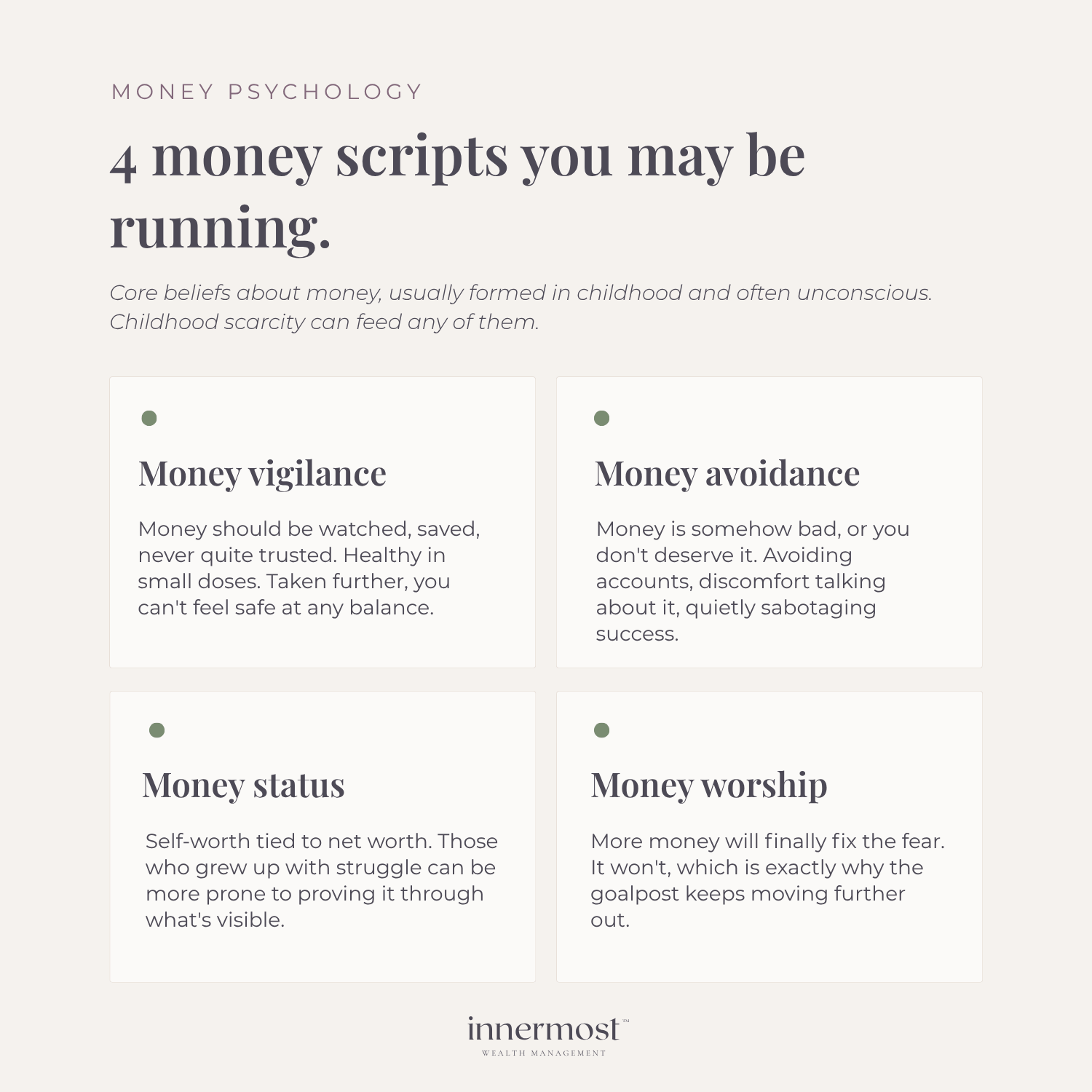
Money scripts are underlying beliefs and attitudes about money that can operate partly outside our awareness and influence how we approach financial decisions.
Research developing the Klontz Money Script Inventory groups these beliefs into four broad patterns:
money vigilance
money avoidance
money status
money worship
These categories are best used as a framework for reflection, not as fixed personality types or diagnoses. Most people will recognize themselves in more than one pattern, and their beliefs may change depending on the situation.
Money vigilance.
Money vigilance is generally associated with being watchful and careful with money. It may include an emphasis on saving, frugality, privacy, and preparation.
Some vigilance can support healthy financial behavior. It can help someone build savings, avoid unnecessary debt, and think ahead.
Taken too far, however, it may look like secrecy, persistent anxiety, difficulty spending, or the feeling that you can never be careful enough—regardless of how much you have accumulated.
Money avoidance.
Money avoidance can include beliefs that money is bad, that you do not deserve it, or that having too much of it makes someone greedy, selfish, or morally compromised.
In practice, that may look like avoiding bills, delaying financial decisions, feeling uncomfortable discussing money, giving money away impulsively, or disengaging from your finances even when paying attention would help you.
Money status.
Money-status beliefs connect money with success, identity, or personal worth.
Someone with stronger money-status beliefs may place particular importance on what their salary, home, possessions, or financial success communicates about them. Financial setbacks may therefore feel like personal failures rather than simply difficult financial events.
Money worship.
Money worship is the belief that more money will solve your problems or finally make you happier, safer, or more complete.
The difficulty is that when money itself is expected to create a particular emotional state, the amount that feels like “enough” can keep moving.
You reach one goal and immediately create another. The balance changes, but the feeling you expected it to produce does not necessarily arrive with it.
Most of us will not fit neatly into one category, and recognizing some of these beliefs does not mean something is wrong with you.
The framework is useful because it gives you a way to notice the assumptions you may be carrying about money and ask where they came from.
That can be especially relevant when thinking about childhood scarcity. If money was unpredictable or stressful growing up, what you learned may still influence how you approach saving, spending, success, and security today.
A 2025 preliminary study also found an association between family financial socialization and money vigilance, supporting the broader idea that what we observe and learn about money may influence the attitudes we carry forward.
That does not mean childhood experiences determine your financial behavior. They are one possible influence among many.
Why scarcity can make financial decisions more difficult.
The beliefs we carry forward are only one part of the picture. Scarcity may also affect how we think and make decisions while we are experiencing it.
Behavioral economist Sendhil Mullainathan and psychologist Eldar Shafir studied what can happen when people are preoccupied with not having enough.
Their work suggests that scarcity can do more than create a financial problem. It can capture attention and leave less mental capacity available for other tasks.
They describe this as a bandwidth tax.
Think of bandwidth as the mental space available for planning, comparing tradeoffs, exercising self-control, remembering details, and thinking ahead.
When part of your mind is constantly occupied with making rent, paying the next bill, or deciding which expense can wait until payday, less bandwidth may be available for everything else.
That creates an important distinction from simply being “bad with money.”
Someone living with scarcity may make decisions that look shortsighted from the outside while actually trying to manage several urgent problems competing for limited money and attention.
There is also an important limit to what this research tells us.
The bandwidth framework describes what may happen while scarcity is present. When the pressure lifts, some of that mental capacity may return. It does not mean that growing up with financial scarcity permanently damaged your ability to make good financial decisions.
Later research has also produced a more nuanced picture, with the strength of scarcity effects varying by context and by the type of cognitive task being measured. The framework is useful, but it is not a complete explanation for every decision made under financial pressure.
What may last longer are some of the beliefs developed through those experiences.
If you spent years watching money run short, worrying about costs, or never feeling certain that there would be enough, some of those beliefs may remain even after your circumstances improve.
That is where the distinction between having enough and feeling like you have enough begins to matter.
Why you can feel financially anxious even when you have enough.
Financial security and financial anxiety can exist at the same time.
You can objectively have enough money and still struggle to trust that it is enough.
If you spent years worrying about money, building wealth may have become about more than reaching a financial goal. It may have represented safety.
You save more, earn more, or reach the number you thought would finally allow you to relax. But when you get there, the feeling does not necessarily change with the balance.
Your financial circumstances and your beliefs about money do not always change at the same pace.
The numbers may indicate that you are secure. You may understand that intellectually and still hesitate to spend, worry about losing what you have built, or feel that you need a little more before you are allowed to relax.
That can create a strange disconnect.
Someone who was once genuinely worried about having enough may continue making decisions around that possibility long after her finances have become more stable.
Saving more can still feel safer than spending. A normal market decline can feel more threatening than the financial plan suggests it should. Even spending money on something you deliberately planned for and can comfortably afford may feel irresponsible.
This is where understanding your money history becomes useful.
The goal is not to blame every decision on childhood or assume that financial anxiety proves something deeper is wrong. It is to notice when the way you feel about money may not match the financial circumstances you are living in now.
Sometimes that disconnect appears in everyday behavior before you recognize where it may be coming from.
Signs your past experiences may be shaping how you handle money.
You do not need to label yourself to notice that some financial behaviors may not match your current circumstances.
If several of these feel familiar, they may be worth exploring:
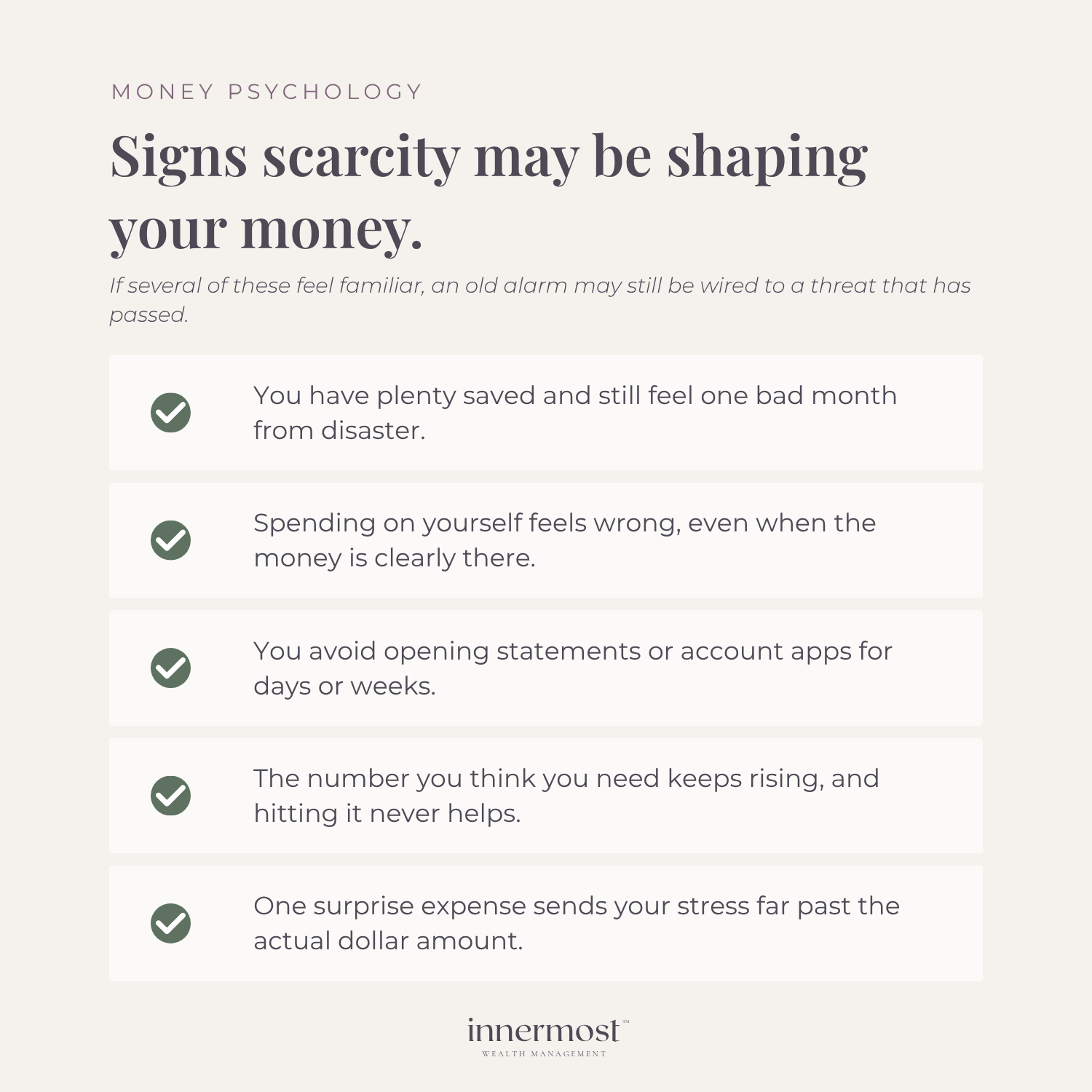
You have substantial savings but still feel as though you are one bad month away from disaster.
You check your balances much more frequently than your finances require.
Spending on yourself feels wrong or wasteful even when you can comfortably afford it.
You avoid opening bills, statements, or financial apps for days or weeks at a time.
An unexpected expense produces much more distress than the actual cost would suggest.
You keep raising the amount you believe you need before you will feel safe, but reaching each goal changes very little.
Money conversations make you tense, defensive, or eager to leave the conversation.
You feel compelled to track every dollar—or have difficulty looking at your finances at all.
You delay decisions because no option feels financially safe enough.
Reassurance helps temporarily, but the same fear returns soon afterward.
Any one of these can occur for many reasons.
If you recognize yourself in several of them, it may be worth becoming curious about what is driving the pattern.
What did you learn about money growing up? Which experiences shaped those beliefs? Do those beliefs still match the financial circumstances you are living in today?
Four questions to sit with.
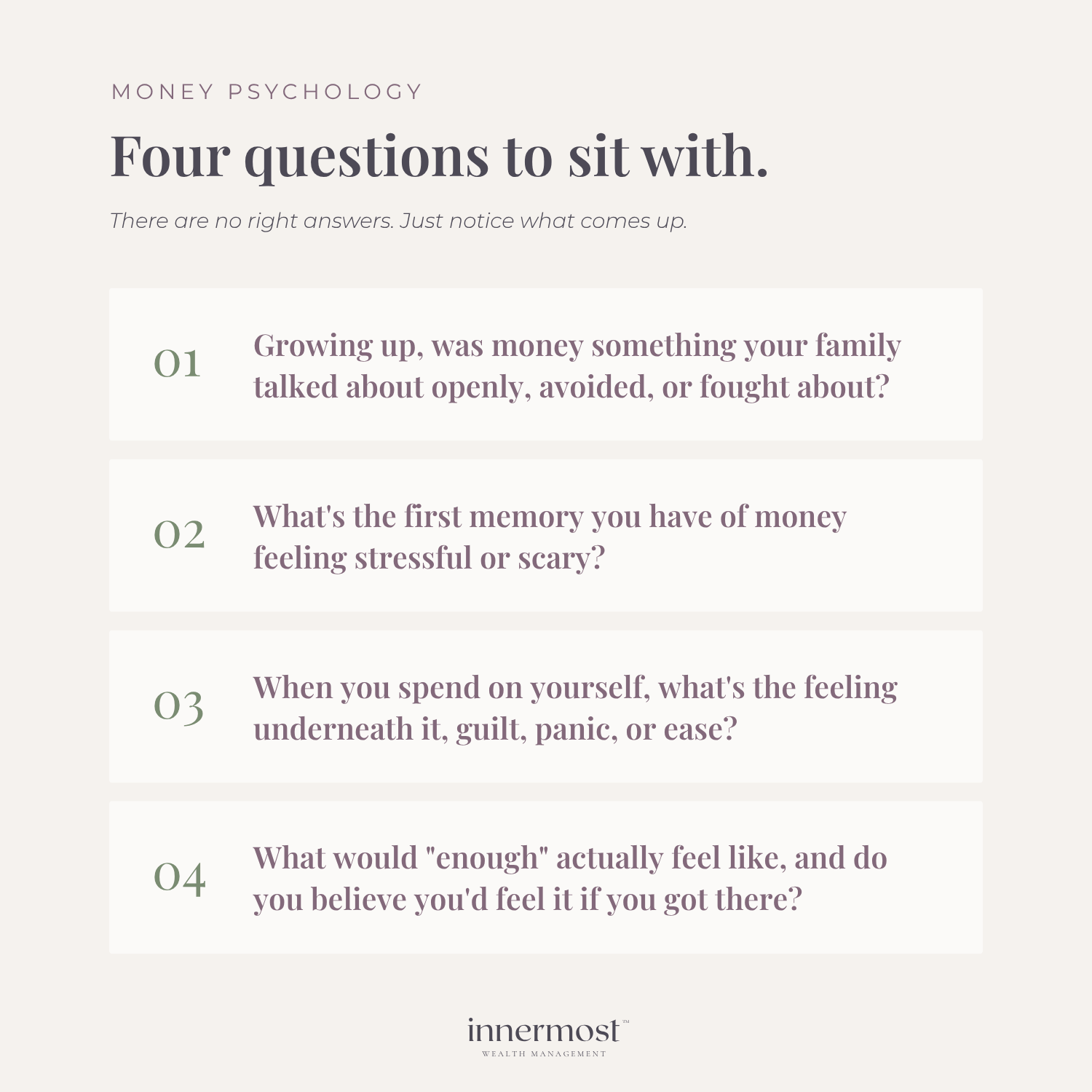
You can begin understanding your own money story by considering four questions.
There are no correct answers. Notice what comes up without pressuring yourself to produce a particular insight.
1. Growing up, was money something your family discussed openly, avoided, or fought about?
Think not only about what people said, but about what you observed.
Who controlled the money? Who worried about it? What happened when an unexpected expense appeared? Were questions welcomed, dismissed, or treated as inappropriate?
2. What is your earliest memory of money feeling stressful or uncertain?
It may be a major event, such as a job loss or foreclosure. It may also be something small that stayed with you: hearing an argument, seeing a parent panic at the grocery store, or realizing that an activity cost more than your family could afford.
3. When you spend money on yourself, what feeling appears first?
Is it ease, guilt, fear, embarrassment, excitement, or the urge to justify the purchase?
The purpose is not to decide whether the feeling is reasonable. It is to notice the reaction that appears before you have had time to analyze it.
4. What do you imagine “enough” would allow you to feel or do?
Would you rest more? Change careers? Travel? Stop checking your accounts? Feel less responsible for everyone around you?
Then ask whether reaching previous financial goals produced that feeling—or whether the target moved again.
Write your answers down if you can. Sometimes seeing them together makes the patterns easier to recognize.
You do not need to force an answer, and you can stop if the exercise becomes distressing.
If these questions bring up something that feels larger than financial planning, that may be a good reason to involve a licensed therapist or financial therapist.
How financial planning can help.
Understanding where a financial behavior may come from can be useful, but insight alone does not automatically change it.
This is where financial planning can become part of the process.
It is important to be clear about what that means.
Innermost Wealth Management is a financial-planning firm, not a therapy practice. Our approach is informed by research in financial psychology and by the understanding that financial decisions are shaped by more than numbers.
We can help clients understand how a pattern affects a financial decision, but we do not diagnose or treat psychological or emotional conditions. A licensed mental-health professional can help with concerns that extend beyond the scope of financial planning.
Within financial planning, one of the first things we can do is separate what you are feeling from what the numbers are actually showing.
If you are checking your balance four times a day because you are worried there will not be enough, for example, we can examine whether there is a financial problem that needs to be addressed—or whether the financial evidence points to a different conclusion.
A financial plan also gives you something more concrete than reassurance.
Instead of simply saying that you are fine, we can show you:
what you have
how much you are saving
what you can afford
what could happen under different market conditions
how a major decision affects the rest of the plan
where genuine risks exist
where the plan has room
If you are worried about spending, we can model the trip, the home project, the career change, the gift, or whatever else you are considering and see what it actually does to the plan.
For someone who has spent a lifetime saving, that can make spending part of the planning process too.
The goal is not to convince you to spend more. It is to help you understand what you can spend without compromising the priorities that matter to you later.
Sometimes having the math behind a decision makes it easier to give yourself permission to make it.
Planning can also create practical guardrails.
That might mean:
identifying the amount of cash you genuinely need to feel prepared
setting a planned spending amount for travel or personal priorities
creating rules for when you will and will not check your accounts
distinguishing market volatility from an actual threat to the plan
agreeing in advance on what would cause the plan to change
revisiting decisions after the emotional intensity has passed
None of this requires digging into your childhood during every financial conversation.
Some clients want to understand where their patterns came from, and that context can be useful. Others would rather focus on the financial decision directly in front of them.
Both approaches are completely valid.
The point is to build the planning process around the person making the decisions rather than assuming the numbers alone tell us everything we need to know.
Your money habits can change.
Your past experiences with money may help explain some of the beliefs and behaviors you have today, but they do not have to determine every financial decision you make going forward.
That is the value of understanding your money history.
You can begin distinguishing between a financial concern that genuinely needs to be solved and a familiar fear that may no longer match your circumstances.
Sometimes the answer is to change the plan.
Sometimes the numbers show that the plan is already doing what it needs to do and the next step is learning how to trust and use it.
Good financial planning should leave room for both.
If you would like a financial planner who considers both the numbers and the person making the decisions, we would be glad to talk.
Frequently asked questions about financial trauma and scarcity.
-
Financial trauma is the lasting emotional and behavioral imprint left by distressing experiences with money, often beginning in childhood. It isn't a formal clinical diagnosis, but the pattern is well documented in financial psychology. People with financial trauma may feel persistent anxiety about money, an inability to feel financially safe regardless of their actual balance, or a pull toward extreme saving, spending, or avoidance that doesn't match their real financial picture.
-
Yes, childhood scarcity can strongly affect how you handle money as an adult. Growing up with financial instability, unpredictability, or lack tends to install unconscious beliefs about money, often called money scripts, that operate for decades. These beliefs form early, frequently in response to an emotionally charged financial moment, and can be resistant to change even when they no longer match your circumstances.
-
Feeling broke despite having enough is a common sign of financial trauma, particularly from childhood scarcity. If money once felt like the only thing standing between your family and disaster, building wealth becomes about escaping a feeling rather than reaching a number, so the security arrives but the fear doesn't leave with it. The feeling was never really about the balance, which is why a bigger balance doesn't resolve it.
-
Money scripts are core, usually unconscious beliefs about money that drive financial behavior. Researchers Brad and Ted Klontz identified four broad patterns: money avoidance, money worship, money status, and money vigilance. They typically form in childhood, are passed down within families, and are often only partial truths, which is why they can work against you as an adult without your ever seeing it.
-
No, struggling with money is generally not a character flaw. Behavioral research shows that financial stress itself imposes a cognitive load, sometimes called a bandwidth tax, that reduces the mental capacity needed for good financial decisions. Difficult money behaviors are usually old survival strategies that outlived the situation that created them, not evidence of weakness or lack of discipline.
-
Yes, you can change your relationship with money, though it takes intention. Naming your patterns, reviewing a clear financial plan that shows what you actually have, and building deliberate permission to spend can give your nervous system new evidence to work with. A financial planner can help with the planning side, and for deeper emotional work, a licensed financial therapist is a valuable partner.
This material is provided for general educational purposes and is not individualized financial or mental-health advice. “Financial trauma” is not used here as a formal diagnosis, and the behaviors described can have many possible causes. Innermost Wealth Management is a financial-planning firm and does not provide psychotherapy or diagnose or treat mental-health conditions. A licensed mental-health professional can help with emotional or psychological concerns that extend beyond financial planning.