
When Ego Enters the Portfolio: What Behavioral Finance Reveals About Confidence and Bias in Investing

Key Takeaways
Investment decisions are influenced not only by markets and data, but also by the psychology of the people making those decisions.
Behavioral finance research shows that biases such as overconfidence and self-attribution can influence how investors interpret success, manage risk, and make future decisions.
Some confidence is useful when making decisions under uncertainty, but research has associated overconfidence with greater trading, risk-taking, and weaker subsequent investment performance in certain settings.
In financial leadership, structured decision processes and intellectual humility can provide useful safeguards against overconfidence and reactive decision-making.
Thoughtful financial planning recognizes that money decisions are rarely purely analytical. They are shaped by emotions, experiences, and life transitions.
Finance likes to present itself as purely rational.
Models. Forecasts. Risk metrics.
But anyone who has worked inside the industry eventually notices something else shaping decisions.
Personality.
In environments where decisions involve large sums of capital, public reputation, and asymmetric power, psychology becomes part of the investment process itself.
And occasionally, something more specific enters the portfolio.
Ego.
A manager who believes their instincts are better than the market.
An investor convinced they have identified an opportunity others are missing.
A portfolio strategy that becomes harder to question as early successes accumulate.
In those moments, the portfolio may no longer be shaped only by analysis.
Behavioral finance research suggests this happens more often than many people realize. And when it does, the consequences can influence everything from trading behavior to long-term investment outcomes.
Understanding how confidence and bias shape financial decision-making offers an important lens into how investment leadership actually works.
What the research shows.
A 2023 working paper by Meng Wang provides one example of how these psychological dynamics can appear in professional investment management.
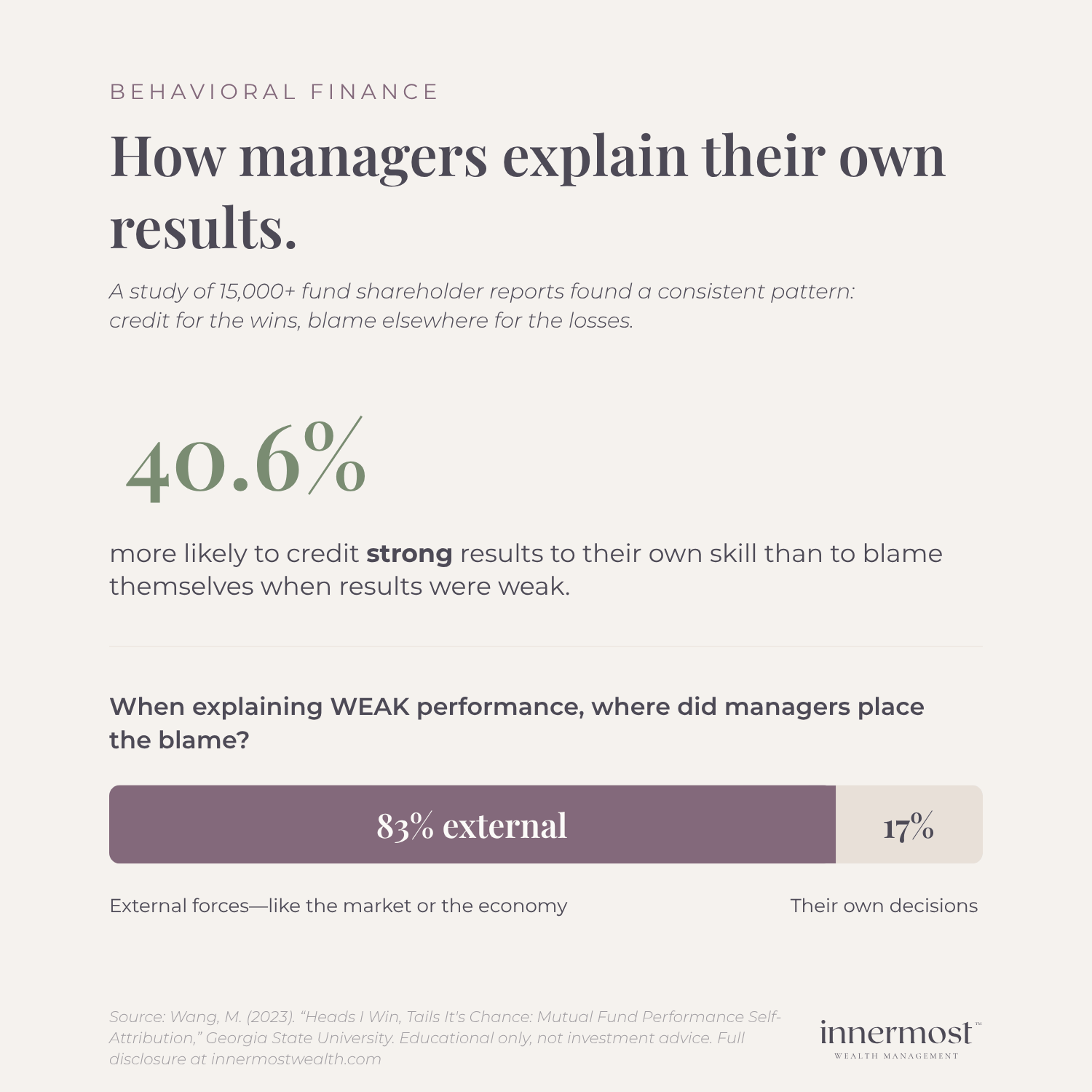
Wang analyzed 15,434 shareholder reports from 1,969 mutual funds, using a GPT-based natural-language-processing model to examine how fund managers explained factors that contributed to or detracted from investment performance.
The pattern was striking. On average, managers were more likely to attribute positive performance contributors to internal factors, such as their own investment decisions, while attributing performance detractors to external factors.
Wang found that managers were 40.6% more likely to attribute performance contributors than performance detractors to internal factors. Among factors identified as performance detractors, 83% were attributed to external factors and 17% to internal factors.
Psychologists generally refer to this tendency as self-attribution bias: the tendency to give ourselves greater credit for positive outcomes while assigning more responsibility for negative outcomes to circumstances outside our control.
What makes Wang’s research particularly interesting is what happened afterward.
Funds displaying stronger self-attribution bias subsequently engaged in more trading and greater risk-taking. Those behaviors were also associated with weaker subsequent investment performance. Wang concluded that the pattern was more consistent with cognitive bias than with managers strategically choosing how to describe their results.
The effect was measurable. A published summary of Wang’s results reports that a one-standard-deviation increase in the self-attribution score was associated with approximately 0.8% lower cumulative performance over the subsequent reporting period. In plain language, funds whose managers showed stronger self-attribution bias tended to perform worse in the following reporting period.
One possible explanation is that attributing past success primarily to personal skill can reinforce confidence in future judgments. If that confidence becomes excessive, it may make a decision-maker more willing to trade, take additional risk, or place greater weight on their own conclusions.
That does not mean confidence itself is a problem. The more important question is whether confidence remains calibrated to the available evidence.
Overconfidence in financial decision-making.
Self-attribution bias often operates alongside another well-documented behavioral pattern: overconfidence.
Overconfidence can occur when people place too much confidence in their own judgments, abilities, or forecasts.
In financial markets, this phenomenon has been studied extensively.
One of the most influential studies in the field comes from economists Brad Barber and Terrance Odean, who analyzed the trading behavior of more than 66,000 brokerage households.
Their research found a striking pattern: the investors who traded most frequently earned substantially lower net returns than those who traded less often.
Higher trading activity can create additional transaction costs and other frictions. In Barber and Odean’s sample, those costs contributed to the weaker net performance of the most active households.
Barber and Odean argued that overconfidence could help explain why investors traded so frequently despite the performance penalty associated with that activity.
The point is not that every active investor is overconfident. It is that too much confidence in one’s own judgment can influence behavior in ways that may work against long-term investment results.
Confidence vs. calibration.
Confidence itself is not necessarily a problem.
Decisions often have to be made under uncertainty, and some degree of confidence can help people act without having perfect information.
The more useful question is whether that confidence is well calibrated. In other words, whether confidence roughly matches the strength of the evidence.
Research on judgment and decision-making has documented several forms of overconfidence, including overestimating one’s performance and being more certain about a judgment than the available evidence warrants.
In investing, that matters because excessive confidence can make it harder to recognize uncertainty, incorporate conflicting information, or reconsider an existing view.
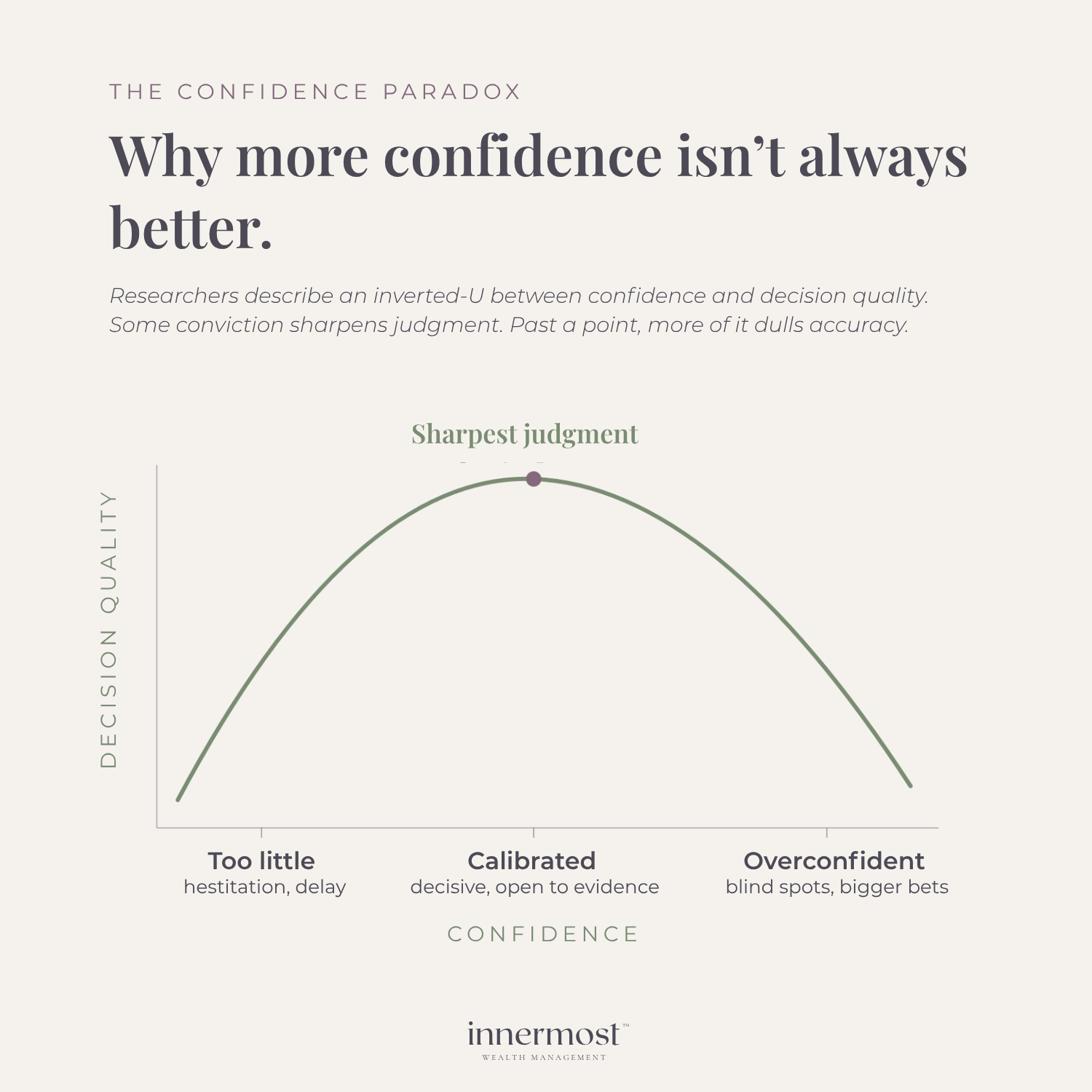
A conceptual illustration to think about confidence. Not an empirical estimate.
Personality and leadership in finance.
These psychological dynamics do not only affect individual investors. They can also appear in corporate leadership.
Economists Ulrike Malmendier and Geoffrey Tate have studied overconfidence among corporate executives, using CEOs’ personal investment behavior as one measure of overconfidence.
Their research found that executives classified as overconfident displayed different corporate investment behavior. In a 2005 study, investment by overconfident CEOs was more sensitive to the amount of internal cash available to the company, consistent with greater investment when internal financing was abundant.
In separate research on mergers and acquisitions, Malmendier and Tate found that CEOs classified as overconfident were more likely to pursue acquisitions, particularly when internal financing was readily available.
Although this research focuses on corporate executives rather than financial advisors or individual investors, it illustrates a broader point: confidence can affect not only how people interpret information, but also the financial decisions they make.
The financial industry often rewards individuals who project confidence and decisiveness. Media coverage, conference panels, and industry rankings frequently highlight bold predictions and strong personalities.
Those traits can be valuable.
But they can also amplify behavioral biases if they are not balanced by disciplined decision frameworks.
Why finance often rewards certainty.
Part of the challenge lies in how financial expertise is communicated.
Clients naturally want reassurance. Markets can be volatile and emotionally taxing, and people often seek professionals who appear confident in their guidance.
Public commentary reinforces this dynamic.
Investment professionals are frequently asked to provide definitive views about where markets are heading next. Forecasts and predictions tend to attract more attention than discussions about uncertainty or probability.
Certainty can be persuasive.
But markets are inherently uncertain systems influenced by countless variables.
The professionals who sound the most confident are not always the ones making the most thoughtful decisions.
In some cases, the opposite may be true.
Some advisors focus less on predicting markets and more on designing decision frameworks that help clients navigate uncertainty.
What to look for in a financial advisor.
or individuals evaluating a financial advisor or investment manager, understanding these psychological dynamics can offer useful perspective.
Technical knowledge and credentials matter. But it can also be useful to understand how a professional approaches decisions when the answer is uncertain.
Several characteristics may offer insight into that decision-making process.
Willingness to acknowledge mistakes
Markets involve uncertainty, and even well-reasoned decisions do not always produce the expected result. A willingness to revisit past decisions and discuss what was learned can provide insight into how an advisor evaluates their own judgment.
Transparency about decision frameworks
A clear investment process can help clients understand how decisions are made, what factors are considered, and what might cause the approach to change.
Consistency of philosophy
A consistent investment philosophy can provide a framework for making decisions through changing market conditions. At the same time, consistency does not mean refusing to adapt when facts or circumstances change.
Intellectual humility
Markets are complex and uncertain. A willingness to acknowledge those limits, consider conflicting evidence, and revise assumptions when appropriate can be part of a disciplined decision process.
The role of behavioral awareness.
One of the most important developments in modern finance has been the growing recognition that psychology plays a central role in financial outcomes.
Traditional economic models once assumed investors behaved as purely rational actors.
Behavioral economists such as Daniel Kahneman and Amos Tversky demonstrated that human decision-making is systematically influenced by cognitive biases, framing effects, and emotional responses.
Investors interpret information through mental shortcuts and past experiences.
Financial professionals are no different.
The goal is not to eliminate these biases entirely. That would be unrealistic.
But awareness of them can improve decision processes.
Many thoughtful investment organizations incorporate behavioral safeguards such as structured investment committees, systematic portfolio rules, and deliberate review processes designed to challenge assumptions.
In many ways, humility becomes a form of risk management.
A different model of financial leadership.
The longer I work in financial planning, the more convinced I become that thoughtful financial leadership often looks different from the stereotype associated with the industry.
Markets are complex systems. Even highly skilled professionals cannot consistently predict short-term outcomes with certainty.
A different model of advisory work emphasizes process over prediction, risk management over bold narratives, and a willingness to revise assumptions as circumstances change.
And perhaps most importantly, they recognize that financial planning is not solely about investments.
It is about people.
Clients bring their family histories, life transitions, and personal values into financial decisions. These realities shape how risk is perceived and how financial choices are made.
Addressing those factors requires more than technical expertise.
It requires attention, patience, and emotional awareness.
Why this topic matters to me.
Part of what deepened my interest in behavioral finance and psychology early in my career was my own experience working inside the financial industry.
I studied both finance and psychology in school and had always been fascinated by how people think, make decisions, and respond to uncertainty. But as I began working in financial environments, that interest quickly became more than academic.
I found myself increasingly drawn to the research behind behavioral finance, decision-making, and personality dynamics. The more I observed how financial decisions were actually made in practice, the more I wanted to understand the psychological forces shaping those choices.
At the same time, I sometimes felt slightly out of place in traditional industry environments. In some of those environments, success seemed to reward a particular type of personality: highly extroverted, assertive, comfortable projecting certainty, and aligned with the traditional image of authority that has long shaped the industry.
Those traits can certainly be valuable.
But over time I noticed something interesting.
Many of the qualities that make someone a thoughtful financial advisor do not always look like traditional “industry confidence.”
They often look quieter.
Listening carefully before offering advice.
Paying attention to subtle emotional cues in conversations about money.
Recognizing when fear, family history, or past experiences are shaping financial decisions.
Asking thoughtful questions before presenting answers.
In other words, the skills that build trust with clients are often the ones that receive the least attention inside the industry.
Empathy.
Curiosity.
Patience.
Emotional awareness.
For a time, I wondered whether those traits meant I simply did not fit the profession.
Eventually I realized something different.
Those qualities are not weaknesses in financial planning.
They are strengths.
Clients rarely seek financial advice because life feels predictable. They come during moments of transition: career changes, divorce, family decisions, inheritance, or uncertainty about the future.
In those moments, what people often need is not someone performing certainty.
They need someone who can listen carefully, think clearly, and guide decisions with both technical knowledge and emotional intelligence.
Final thoughts.
Finance will always involve uncertainty.
Markets rise and fall. Strategies evolve. Economic conditions shift.
But one constant remains.
The psychology of decision-makers matters.
Behavioral finance research continues to show that biases such as self-attribution and overconfidence influence how investment professionals interpret success, manage risk, and make future decisions.
For investors, understanding those dynamics provides another lens for evaluating financial leadership.
Credentials and experience matter.
But so do judgment, transparency, and intellectual humility.
In an industry built on forecasts and confident predictions, the most valuable skill may simply be the ability to approach financial decisions with humility about what cannot be known.
For investors who want to explore how behavioral awareness can inform long-term financial decisions, you’re welcome to schedule a conversation here.
Frequently asked questions about behavioral finance.
-
Behavioral finance is a field of study that examines how psychology influences financial decision-making. Traditional economic models assume investors behave rationally, but behavioral finance research shows that emotions, cognitive biases, and personal experiences often influence how people evaluate risk, interpret information, and make investment decisions.
-
Overconfidence can lead investors to overestimate their ability to predict market movements or select winning investments. Research has shown that overconfident investors tend to trade more frequently, take larger concentrated bets, and underestimate risk, behaviors that can reduce long-term investment returns.
-
Self-attribution bias occurs when investors attribute successful outcomes to their own skill while blaming negative results on external factors such as market conditions or economic events. Behavioral finance research shows that this bias can increase confidence after periods of success, sometimes leading to riskier investment decisions.
-
Financial decisions are rarely based on numbers alone. Life transitions, past experiences with money, family dynamics, and personal values all influence how people think about risk and financial goals. Financial planning that incorporates behavioral awareness can help investors make more thoughtful and sustainable long-term decisions.
-
Choosing a financial advisor is about more than credentials, though those matter too. Beyond technical qualifications, it's worth paying attention to how an advisor approaches uncertainty: whether they're transparent about their decision-making process, consistent in their philosophy, and willing to acknowledge what they don't know. Markets deal in probabilities, not guarantees, so an advisor who discusses risk honestly rather than projecting certainty is often demonstrating exactly the kind of discipline that serves clients well over time. Fee structure matters as well; a fee-only fiduciary is legally required to act in your best interest.
-
A few questions can reveal a great deal about how an advisor actually works. Ask how they make investment decisions, how they've handled past mistakes, how they're compensated, and whether they're a fiduciary. Their answers tell you whether there's a clear, repeatable process behind their advice or mostly confidence and prediction. An advisor who can walk you through their framework, and who talks candidly about uncertainty rather than promising outcomes, is showing you the thinking you'll be relying on for years.
-
Several well-documented biases affect how people invest, often without their noticing. Two of the most consequential are overconfidence, the tendency to overestimate our ability to predict outcomes, and self-attribution bias, the tendency to credit success to our own skill while blaming losses on outside forces. Others include loss aversion, where the pain of a loss outweighs the pleasure of an equivalent gain, and recency bias, where recent events feel more important than they are. The pioneering work of psychologists Daniel Kahneman and Amos Tversky showed these patterns are systematic and human, not signs of poor judgment. Awareness of them is what allows for better decision processes.
Sources
Wang, M. (2023, revised 2024). Heads I Win, Tails It's Chance: Mutual Fund Performance Self-Attribution. SSRN working paper.
Barber, B. M., & Odean, T. (2000). Trading Is Hazardous to Your Wealth: The Common Stock Investment Performance of Individual Investors. Journal of Finance, 55(2), 773–806.
Malmendier, U., & Tate, G. (2005). CEO Overconfidence and Corporate Investment. Journal of Finance, 60(6), 2661–2700.
Malmendier, U., & Tate, G. (2008). Who Makes Acquisitions? CEO Overconfidence and the Market's Reaction. Journal of Financial Economics, 89(1), 20–43.
Moore, D. A., & Healy, P. J. (2008). The Trouble With Overconfidence. Psychological Review, 115(2), 502–517.